The Wei Zhi Woren Zhuan (Account of the Wa People in the Records of Wei, compiled c. AD 297) is the only contemporary foreign account of third-century Japan and the principal source for the centuries-old debate over the location and nature of the kingdom of Yamatai. Despite extensive scholarship, consensus remains elusive. This paper argues that the fundamental obstacle is a pervasive preconception—here termed the “Yamatai Hegemonic-State Theory”—that reads the Wei Zhi as portraying a powerful, militaristic state. Through close re-examination of key passages, combined with an independent Bayesian radiocarbon analysis, the paper dismantles this preconception on multiple fronts. The Harunari–Rekihaku radiocarbon model (Hashihaka Tumulus (箸墓古墳; a large keyhole-shaped burial mound in Sakurai City, Nara Prefecture) = AD 240–260), which underpins the Kinai hypothesis (畿内説; the theory placing Yamatai in the Kinai region—the ancient capital provinces around present-day Nara and Osaka), is shown to yield an Agreement Index (Amodel) of only 16% under IntCal20—far below the international acceptance threshold of 60%—while an alternative model places Hashihaka in the late third to early fourth century, eliminating the chronological basis for identifying it as Himiko’s tomb. Re-reading the Wei Zhi as a bureaucratic field report rather than a literary text reveals that: the Ichidaisotsu was a civil logistics official, not a military commander; widespread polygyny reflected a broad clan-internal widow-retention practice arising from catastrophic male war mortality exceeding 50%; the thousand female attendants were war widows sheltered under Himiko’s authority; and tribute missions to Wei were primarily requests for military aid against Kuna-koku. A reanalysis of the official title Kukochi-hiku (狗古智卑狗) demonstrates that Kikuchi was Kuna-koku’s conquest target—not its domain—placing Yamatai in the Kikuchi River basin of present-day Kumamoto Prefecture. The Shira-kawa River is identified as the de facto Late Yayoi boundary between the two polities, supported by the distinct archaeological distributions of Menda-type and Nobeta-type pottery. Taken together, these findings suggest that the Queen’s realm, including Yamato-koku (邪馬壹国), was not a powerful state but a small confederation on the brink of extinction.
Keywords: Yamatai; Yamato-koku (邪馬壹国); Wei Zhi Woren Zhuan; Himiko; Bayesian radiocarbon dating; widow-retention practice; levirate marriage; stepmother marriage; Kuna-koku; Kikuchi River basin; Yayoi period; Old Japanese phonology; Class A vowel; 山門
The academic debate surrounding Yamatai is one of the largest and most multifaceted controversies in ancient Japanese history. Unusually, not only scholars but also members of the general public interested in the ancient past have joined the fray. Disputes range across such issues as the location of the kingdom, the meaning of its name, the distances recorded in the sources, the political character of the state, and the identity of the queen Himiko.
Yet why, despite all the discussion, have we still not managed to pinpoint the Yamatai where Himiko resided? This paper argues that the fundamental cause lies in an illusion I call the “Yamatai Hegemonic-State Theory.” It then examines, point by point, the passages in the Wei Zhi Woren Zhuan (Account of the Wa People in the Records of Wei; hereafter “Wei Zhi”) most susceptible to misreading. The argument proceeds along two axes. The first is deconstruction of the great-power hypothesis: removing the preconceptions that lead to an inflated reading of the Wei Zhi. The second is positive reconstruction: presenting the image that emerges once those preconceptions are cleared away—a small confederation of polities in the Kikuchi River basin, fighting for survival. The first axis is the methodological prerequisite that makes the second possible.
The present author’s phonological analysis (Miyazaki, 2025, DOI: 10.5281/zenodo.18065799) demonstrates that 壹 (*ʔjit, stop-final) encodes Old Japanese “to” of Class A (甲類; the “ko” or unmarked vowel class in the Old Japanese distinction known as jōdai tokushu kanazukai, upper ancient special kana usage)—the same syllable preserved in the place name 山門 (Yamato). The stop-final coda (−t) of 壹 captures the phonological closure of Class A “to,” which Class B (乙類; the “otsu” or marked vowel class) “to” does not share. The rival graph 臺 (*dəi) is an open syllable and cannot represent this closure. Consequently, the phonologically correct romanization is Yamato-koku (邪馬壹国)—not “Yamaichi-koku” (a mere kun-reading of 壹 as “ichi”) and not “Yamatai-koku” (based on the corrupt 臺 graph).
This finding simultaneously dismantles the linguistic pillar of the Kinai hypothesis, which retroactively inferred “Yamatai-koku” by back-projecting from the later pronunciation of “Yamato (大和).” The Bainaben text 壹 points to 山門 (Yamato, Kyushu), not to 大和 (Yamato, Kinai—the Nara basin). *The final syllable of the Kinai toponym is Class B (乙類) “to”—a phonologically open syllable that would necessitate an open-syllable graph (such as 都) for its transcription, rendering the stop-final 壹 (ʔjit) phonetically incompatible.
Throughout this paper the phonologically correct form Yamato-koku (邪馬壹国) is used. The conventional label “Yamatai-koku” is retained only where citing other scholars’ positions that employ that name.
The idea of equating Yamatai with Yamato and identifying Himiko with Empress Jingū has existed since at least the Nihon Shoki (the entry for the thirty-ninth year of Empress Jingū’s regency). From the early modern period onward, thinkers such as Arai Hakuseki (Confucian scholar, 1657–1725), Motoori Norinaga (scholar of Japanese classics, 1730–1801), and Kondō Yoshiki (sinologist, 1801–1880) challenged that view by proposing locations in various parts of Kyushu. Gradually the idea took hold that Yamatai was not in Yamato.
The modern scholarly controversy opened in the early twentieth century, when historians from Tokyo and Kyoto Imperial Universities clashed over whether Yamatai lay in Kyushu or in Yamato. Their dispute drew in many subsequent scholars and grew into a major ongoing debate.
After World War II, the Yamatai question spread widely among the public. Debates over the political character of the state proliferated: Fujima Ikuo argued for a confederate model, Inoue Mitsusada for a primitive democracy, and Ueda Masaaki for an emerging ancient autocracy.
The popular boom was ignited by Miyazaki Kōhei (author and amateur historian, 1913–1980) with his book Phantom Yamatai (1967), which drew the general public into the debate. The title of the present paper is borrowed from that work.
Even a century after the modern controversy began, local “hometown Yamatai” theories continue to proliferate across Japan, and the debate remains as unsettled as ever.
From the 2000s onward, radiocarbon (14C) dating began to be applied in earnest to Japanese archaeology. Harunari Hideji (archaeologist, National Museum of Japanese History; hereafter “Rekihaku”) assessed carbonized material from Hashihaka Tumulus using IntCal09—then the international standard radiocarbon calibration curve—and the Rekihaku’s proprietary calibration curve JCAL. He estimated the construction date of Hashihaka Tumulus at AD 240–260 (Harunari et al. 2011). Because this date approximates the year of Himiko’s passing, enthusiasm for the “Kinai hypothesis” (畿内説; placing Yamatai in the Kinai region, the ancient capital provinces around present-day Nara Prefecture) of Yamatai surged. The Harunari–Rekihaku model, however, suffers from two distinct problems—one statistical, one procedural.
Recalculation using IntCal20—the current international standard calibration curve, superseding IntCal09—yields an Agreement Index (Amodel) of only 16%, indicating a serious lack of fit (Sakamoto Minoru, Professor, Department of Informatics and Documentation Studies, National Museum of Japanese History (Rekihaku); PhD (Science), 2022). The international OxCal standard regards 60% or above as acceptable; below 30% is the threshold for statistical rejection. At 16%, the model falls far below that threshold, meaning that its very premises have collapsed. An independent replication by the present author reproduced a value of 19.3% (Miyazaki, 2026a, DOI: 10.5281/zenodo.19121916).
JCAL rests on dendrochronological data compiled by Mitsutani Takumi (dendrochronologist, Nara National Research Institute for Cultural Properties). For more than thirty years, this underlying data was refused to third-party disclosure. After litigation under freedom-of-information law, a portion of processed data was released—but the Tokyo High Court (August 2025) ruled that disclosure of the remaining materials, including the originals, was judicially impossible. Furthermore, multiple researchers have found that even the data that was released appears inconsistent with the values Mitsutani had previously published (Japan Ancient History Network, December 2025).
The logical chain is therefore clear. Since the Mitsutani data cannot be independently verified, JCAL built upon it cannot be verified either, and the Harunari model that uses JCAL is likewise unverifiable. A date estimate based on an unverifiable calibration curve cannot constitute scientific proof.
The present author constructed an alternative model that, following approaches also used by other researchers, excludes pottery-adhered samples, uses a small branch from Hokeno-yama Tumulus (ホケノ山古墳; an early Kofun-period burial mound in Sakurai City, Nara Prefecture, stratigraphically earlier than Hashihaka) as a high-reliability fixed anchor, and employs IntCal20 alone. Its Amodel is 64.9%, satisfying the international standard. Under this model, the date of Hashihaka converges on the late third to early fourth century AD (c. 280–320s), eliminating the chronological basis for the equation “Hashihaka = Himiko’s tomb.” The OxCal code and sample data underlying this model are fully published within the companion paper (Miyazaki 2026a), enabling independent replication by third parties. For details, see (Miyazaki 2026a, DOI: 10.5281/zenodo.19121916).
When we sweep away the lingering image of the Kinai hypothesis—now stripped of both its locational and its chronological pillars—where should we seek the true coordinates of Yamatai? The key lies hidden in an unexpected place: the illusion known as the “Yamatai Hegemonic-State Theory.”
That a statistically refuted model could harden into orthodoxy reflects the structural pathology of Japanese archaeology diagnosed by Hosoya (1996), who observed that a field operating without explicit theory resembles blind people feeling different parts of an elephant—each reporting a different animal—and that media and administrative pressures systematically select “high-profile data” over rigorous inference. The “Yamatai Hegemonic-State Theory” critiqued in this paper is precisely that pair of distorting lenses: a Romanticist projection—“a great tumulus must contain a great queen”—lacking any operational or quantitative foundation, and thereby preventing honest engagement with the cold statistical verdict of IntCal20 (Amodel 16%). The insistence on a statistically broken model, compounded by three decades of refused data disclosure, embodies in its most ironic form the trajectory that Hosoya (1996) foresaw thirty years ago.
Many people picture Yamatai roughly as follows:
All of these images, however, result from misreading the Wei Zhi. The sections below examine the key passages that generate these misreadings.
There is a theory that Yamatai stationed troops at Ito and used the Ichidaisotsu to conduct military surveillance of the surrounding polities. This is incorrect. In the Wei state, the cishi (Regional Inspector, 刺史) was a civil office. When a cishi also held military authority, a separate title—zhōumù (Provincial Governor, 州牧)—was used, or the cishi concurrently held a general’s commission distinct from the civil post itself.
The hierarchy of Wei regional officials was as follows:
The Ichidaisotsu, described in the Wei Zhi as “like a cishi,” therefore held a purely civil post. In practical terms, his duties were those of a logistics administrator resident at Ito, a major Yayoi-period trading port.
The true reason why the various polities held the Ichidaisotsu in such awe was not military force. As the Wei Zhi itself records, all parties were required to present themselves at the port for inspection, and no discrepancy was permitted in the tally of documents or gifts (「皆津に詣り、文書・賜遺の物を検察す」). The Ichidaisotsu was a stringent inspection official overseeing trade goods and diplomatic cargo. Crucially, Wa society at the time operated under laws so severe that “light offenders had their wives and children confiscated as slaves; for grave offenses, the entire household and clan were put to death” (其犯法 輕者没其妻子 重者没其門戸及宗族). A single inspection error could therefore mean the annihilation of one’s entire family and kin group. What made the polities tremble was not the threat of swords but this pitiless logistical pressure—the knowledge that the unyielding strictness of a system in which administrative failure carries existential consequences for the entire clan.
“Rate” (率) originally means “commander / director” in classical Chinese (Zhang Mingcheng, scholar of ancient Japanese history, 1992). “Ichidai” (一大) is precisely the “Ichidai” of “Ichidai-koku” (一大国)—the Wei Zhi’s own name for Iki Island. Note that 一大国 is the reading of the Wei Zhi primary text (Bainaben recension); the variant 一支国 appears only from the Hou Han Shu (c. AD 432) onward and represents a post-Wei scribal substitution. This paper follows the Wei Zhi and writes 一大国 throughout. That the Wei Zhi uses 一大 to transcribe Iki is itself consistent with the phonological principle established for the Wei Zhi scribes: closed-syllable Japanese sounds are rendered with closed-syllable Chinese characters, such that 「一」(*ʔjit, stop-final) captures the clipped quality of “Ishi,” and 「大」(*dat, stop-final) encodes the Ishida (石田) district — the core of the island and home of the Hara no Tsuji site — through the syllable-fusion process detailed in the supplementary note below (Miyazaki, 2025, DOI: 10.5281/zenodo.18065799). “Ichidaisotsu” thus means “Director of Ichidai (= Iki / Ishida) affairs” and carries no military connotation whatsoever. The Hara no Tsuji site on Iki and the Mikumo site at Ito were the logistical nodes sustaining what can be called the “Hara no Tsuji–Mikumo Trade Route.”
The Ishida gun (郡, district) of Iki Province (現・壱岐市石田町), home of the Hara no Tsuji site, is the place name directly relevant to the phonetic value of 「一大」. In Old Japanese, 「田 (ta/da)」 is standardly treated as an open syllable. Why then did the Wei Zhi scribe choose the stop-final character 「大」(*dat) to render it?
The most plausible explanation is syncope (vowel syncope / medial vowel loss; 語中音消失) combined with vowel devoicing (母音無声化). The syllable 「石 (ishi)」ends in a voiceless palatal fricative [ʃ]; the following high vowel in 「田 (ta)」is subject to devoicing and weakening between voiceless consonants—a phonologically universal process (cf. English choc'late, veg'table; Latin calidus → Italian caldo; Japanese vowel devoicing in tsuki 「月」). The resulting phonetic realization of 「石田」approaches something like ishi-t·ta, with a perceptible glottal catch—acoustically a closed syllable to the non-native ear of a 3rd-century Wei scribe.
This exception does not apply to 「Kinai Yamato (畿内大和; Yamato Province in the Kinai region, present-day Nara; ト = otsu-class, i.e., Class B)」, for a clear phonetic reason: the preceding syllable 「マ (ma)」is a nasal, which carries no voiceless environment to trigger devoicing or syncope. The three syllables 「ヤ・マ・ト」 remain acoustically distinct and open. The final syllable 「ト」(otsu-class / Class B) cannot be rendered by the stop-final character 「壹」(*ʔjit); if transcribed as an open syllable, a character such as 「都」would be expected, yielding “Yamato-koku” (邪馬都国)—not 「壹」or 「大」(*dat). The consistency of the transcription model—「山門」→「邪馬壹国」 versus 「石田(壱岐国石田郡)」→「一大国」—rests on exactly this context-dependent acoustic distinction. For full treatment see Miyazaki (2025, DOI: 10.5281/zenodo.18065799).
Biologically, the birth ratio of males to females is nearly one to one. If it were normal even for ordinary commoners to have two or three wives, the explanation cannot be an unusually high female birth rate. We must instead conclude that adult males were extremely scarce—most plausibly because large numbers had died in battle.
An alternative explanation might be proposed: that even ordinary men (下戸) were taking women from conquered territories as additional wives. The Wei Zhi’s own vocabulary, however, decisively refutes this. The text distinguishes categorically between sei-kō (生口, “living captives” = slaves) and fu (婦, wife). Female war captives appear in the Wei Zhi explicitly as “female seikō” (女生口)—the imperial rescript acknowledging Yamatai’s tribute reads: “We have received the four male seikō and six female seikō you presented” (奉汝所獻、男生口四人、女生口六人). The polygyny passage uses 婦 throughout, never 生口. Women seized in war would be classified as 生口, not counted among the 婦 of commoner households.
Levirate marriage—the custom, found across many cultures, whereby a man marries his deceased brother’s widow—offers a useful analytical lens, but it is only one sub-type of a broader institutional category. The phrase “ordinary people have two or three wives; women feel no jealousy” can be read as describing an institutional obligation: men of the clan were duty-bound to take in widows who had lost their husbands in combat. The note that “women feel no jealousy” reflects institutional resignation rather than personal desire. For Wei envoys steeped in Confucian values, this would have been a barbarous custom; the discomfort likely explains why the author of the Wei Zhi chose to avoid a direct description. If the average adult male had two wives, the mortality rate of adult males in Yamatai would have exceeded 50%.
Throughout this paper, the term “widow-retention practice” (氏族内寡婦収容慣行) is used to describe this institutional custom in its broadest sense: any arrangement—whether levirate (a brother marrying his deceased brother’s widow), stepmother marriage (a son marrying his deceased father’s widow, as in the Tagishimimi case in Section 4-3), or other clan-internal forms—whereby men of the same clan take in war-bereaved widows. The underlying social logic is consistent across all variants: to prevent the social isolation of women who have lost their protectors, and to prevent strategically significant women and clan assets from passing to rival groups. This is best understood not as a “barbarous custom” but as an institutional survival strategy under conditions of catastrophic male war mortality—a social welfare system born of existential crisis. The Tagishimimi case in Section 4-3 (stepmother marriage) is a variant of this broader category, sharing the same underlying social logic, and is therefore fully consistent with the widow-retention framework defined here.
Under the alternative Bayesian model, the Yamato polity was established around AD 301, in the late third to early fourth century (Miyazaki 2026a, DOI: 10.5281/zenodo.19121916). This makes the Kojiki’s records of the reign of Emperor Jimmu nearly contemporaneous with the world the Wei Zhi describes, and thus a relevant source for customs of the same era.
According to the middle volume of the Kojiki, after Emperor Jimmu’s death his son by a first wife—Tagishimimi no Mikoto—took as his own wife the woman who had been Jimmu’s empress, Himetataraisuzu-hime no Mikoto, making her both his stepmother and his new spouse. In cultural-anthropological terms, this is classified not as levirate (a brother’s widow) but as stepmother marriage (継母婚; a deceased father’s widow). Both, however, are sub-types of the broader widow-retention practice (氏族内寡婦収容慣行) defined in Section 4-2: the underlying social logic is identical—keeping a woman who has lost her husband within the clan, preventing her social isolation, and preventing clan assets from passing to outsiders. This tradition appears only in the Kojiki; the Nihon Shoki omits it entirely.
That omission is revealing. Emperor Jimmu’s expedition departed from Tsukushi Himuka (筑紫日向; the Himuka district of Tsukushi—ancient northern Kyushu) in Kyushu; both Jimmu and Tagishimimi belonged to a group of Kyushu origin. The marriage practice may therefore reflect a custom specific to Kyushu—a value system distinct from that of the indigenous population of the Kinai region (present-day Nara and its environs). For Tagishimimi, taking his stepmother as wife would have been a natural right and a clan obligation; yet viewed from the value system of the indigenous Kinai population (the Nara basin), the same act would have appeared as moral transgression—a contrast that itself stands as corroborating evidence of the cultural gulf between the two groups. The Nihon Shoki’s silence most likely reflects an editorial policy shaped by Confucian ethics: an ancient Kyushu-derived norm that still survived in oral tradition was deemed an “inconvenient truth” unbecoming of an official dynastic history and was excised.
From the standpoint of this paper—which places Yamatai in Kyushu—the correspondence between the Wei Zhi’s marriage customs and those of the Kyushu-origin founders of Yamato is not coincidental. It points to cultural continuity within the same sphere.
The fact that both the inheritance of a father’s widow is recorded in the Yamato founding period, and that the Kume clan’s song (久米歌; an ancient ritual song attributed to the Kume clan, still preserved in the repertoire of the Imperial Household Music Department) preserves a lyric treating the differential treatment of first and second wives as a matter of course, is highly suggestive. This constitutes decisive evidence from Japanese sources that the Wei Zhi’s account of polygyny was not a report of “barbarous customs” but an institutionalized survival practice functioning within a wartime clan society.
★ The specific origins of the Yamato royal lineage and the military background of the eastern expedition will be detailed in a separate paper (in preparation).
The thousand attendants have gathered around Himiko of their own volition, without individual summons; her actual personal care is handled by a single man. In other words, the attendants do not look after Himiko and differ in character from ordinary ladies-in-waiting. This should rather be understood as a reflection of the social reality in which women who had not only lost their husbands and sons—their protectors—to the surge in war deaths, but who had also passed beyond childbearing age and become socially isolated, were being rescued and gathered under the sacred authority of Himiko.
The Wei Zhi records the scale of Yamatai as “approximately 70,000 households,” but given that more than half of adult males were absent (Section IV), the actual situation was an accumulation of households that had lost their breadwinners and protectors. The unusual record of Himiko sheltering a thousand women can be understood not as a system of ordinary ladies-in-waiting but as a reflection of the social reality in which the leading chieftain had no choice but to take responsibility for an enormous population of people without protectors. A society rich in population but lacking working capacity is coherently understood not as evidence of the power of a great state but as the image of a confederacy teetering on the edge of extinction.
The purpose for which Yamatai sent tribute missions to Wei was not to receive a gold seal but to request military assistance in its war against Kuna-koku. The following diplomatic chronology makes this clear.
Envoys were dispatched repeatedly—in 243 and again in 247—even after the gold seal had been granted. Wei ultimately sent military assistance (Zhang Zheng and others). Both facts make clear that Yamatai was on the brink of extinction.
The Wei Zhi records the official title of Kuna-koku as “Kukochi-hiku” (狗古智卑狗; reconstructed 3rd-century pronunciation *kɔʔ-kɔʔ-tij-pij-kɔʔ, “Kokochi-piko”). Substituted into native Japanese vocabulary, this yields “Kikuchi-hiko”—creating the impression that the area around the Kikuchi River in present-day Kumamoto Prefecture was Kuna-koku’s domain of control. Under that reading, Yamatai must lie north of the Kikuchi River basin. This reading, however, contains a serious problem that has gone unnoticed.
“Ichidaisotsu,” as discussed in Section III, means “Director of Ichidai (Iki) affairs”—a title that prefixes the name of the region that is the object of the post. This appears to reflect a naming convention in the Wa polities of the time: official titles were formed by prefixing the place name of the target region. Parallels can be found in later Japanese history. Those who pacified the Kibi region were called “Kibitsu-hiko” (“Prince of Kibi”). The title Seii Taishōgun (Shogun, 征夷大将軍)—literally “Great General Who Subjugates the Eastern Barbarians”—names its target in the same way. It is worth noting that “Ichidaisotsu” represents a jurisdiction-type title—the prefixed place name (Iki) designates the area of administrative responsibility—while Seii Taishōgun and “Kukochi-hiku” represent a conquest-target type—the prefixed name designates the region to be subjugated (Emishi/蝦夷 for Seii Taishōgun; Kikuchi/狗古智 for Kukochi-hiku). Both are coherent sub-categories of the same overarching convention: embedding a geographically associated territory in the official title.
Applying this convention to “Kukochi-hiku,” the interpretation reverses fundamentally. “Kukochi” (菊池, Kikuchi) was not Kuna-koku’s domain of control. It was the name of the region that Kuna-koku was attempting to conquer—prefixed to the official title. In other words, Kukochi-hiku means “General for the Conquest of Kikuchi.”
It must be acknowledged that the surviving record of Wa official titles in the Wei Zhi is limited by the nature of the source itself. The argument here does not rest on statistical frequency but on the internal consistency of the two attested cases—Ichidaisotsu and Kukochi-hiku—and their structural parallel with later Japanese titulature. Where the primary source provides only two data points, the methodologically appropriate response is not to multiply hypothetical examples but to test whether those two cases cohere under a single consistent rule. They do.
Kikuchi Hideo (archaeologist and historian), in his book Yamatai, Kuna-koku, and Iron, defines Kukochi-hiku as “the frontline commander of Higo Kuna-koku (肥後の狗奴国; Kuna-koku of Higo Province, present-day Kumamoto Prefecture) against the Queen’s confederation.” But the “frontline” in question faced a base that was, precisely, Kukochi (Kikuchi). This is not evidence that Kikuchi was under Kuna-koku’s control; it is evidence that Kikuchi was Kuna-koku’s top-priority conquest target.
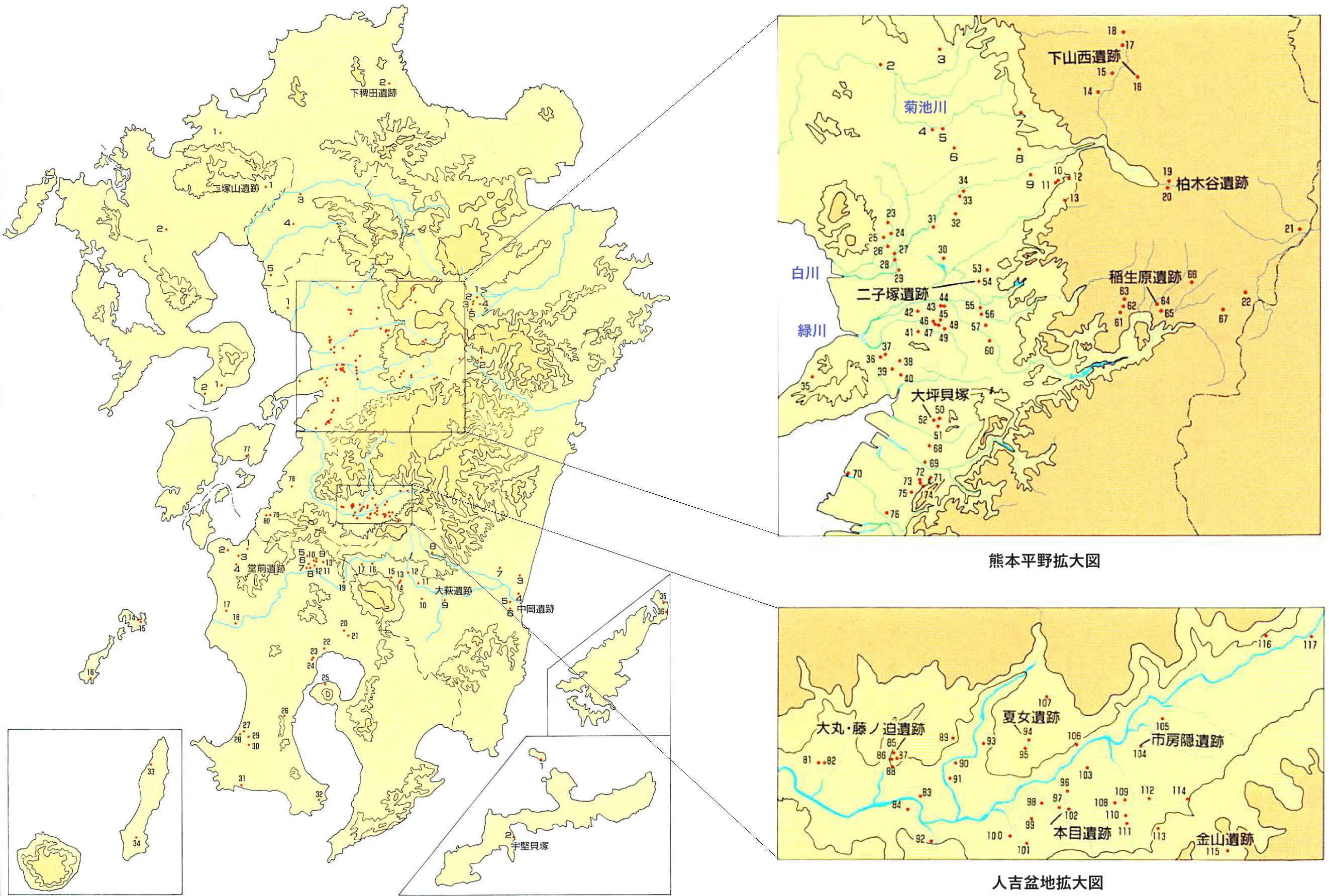
Phonologically, there is a consonant gap between Kuna (*koʔ-nɔ) and Kuma (球磨), but this can be explained by Wei’s deliberate use of pejorative characters—狗 (“dog”) and 奴 (“slave/barbarian”)—when referring to the enemy of its ally the Queen’s kingdom, prioritizing political denigration over phonetic accuracy. “Kuna (Kuma)” is identified with the area from the southern Kumamoto Plain to the Hitoyoshi Basin (人吉盆地; present-day Hitoyoshi City and surrounding area, southern Kumamoto Prefecture; broadly, present-day Kumamoto City to the northwestern part of Kagoshima Prefecture). The dense distribution of Menda-type pottery in late-Yayoi Kumamoto Prefecture, centered on Kuma-gun (球磨郡; Kuma District, southern Kumamoto Prefecture), also supports this identification.
The battle line thus ran as follows: Kuna-koku, based in Kuma, pushed northward into the Kumamoto Plain to attack Yamatai, which had its stronghold in the Kikuchi River basin. The title “Kukochi-hiku” names the commander of that frontline. The desperate urgency with which Yamatai kept pleading with Wei for military aid is explained by this geopolitical pressure—Kuna-koku’s offensive closing in on the Kikuchi River basin.
The equation “Kumamoto Prefecture = Kuna-koku” circulates like received wisdom, but it is a crude binary divorced from archaeological reality. Two clearly distinguishable cultural spheres, identified by pottery distribution, coexisted in late-Yayoi Kumamoto Prefecture.
In the Middle Yayoi period, the jar-burial tradition that flourished in northern Kyushu spread widely across the Kumamoto Plain, extending southward to the Uto Peninsula area (宇土半島; a peninsula jutting into the Ariake Sea, present-day Uto City, Kumamoto Prefecture). In the Late Yayoi period, however, this jar-burial practice rapidly disappeared from the Kumamoto Plain. Expanding in its place was Menda-type pottery, centered on finds at Menda-chō in Kuma-gun (球磨郡; Kuma District, southern Kumamoto Prefecture) (Kumamoto Prefectural Museum of Decorated Tumuli, Prayers of Yayoi People: The Mystery of Menda-type Pottery, Exhibition Catalogue 3, 1993).
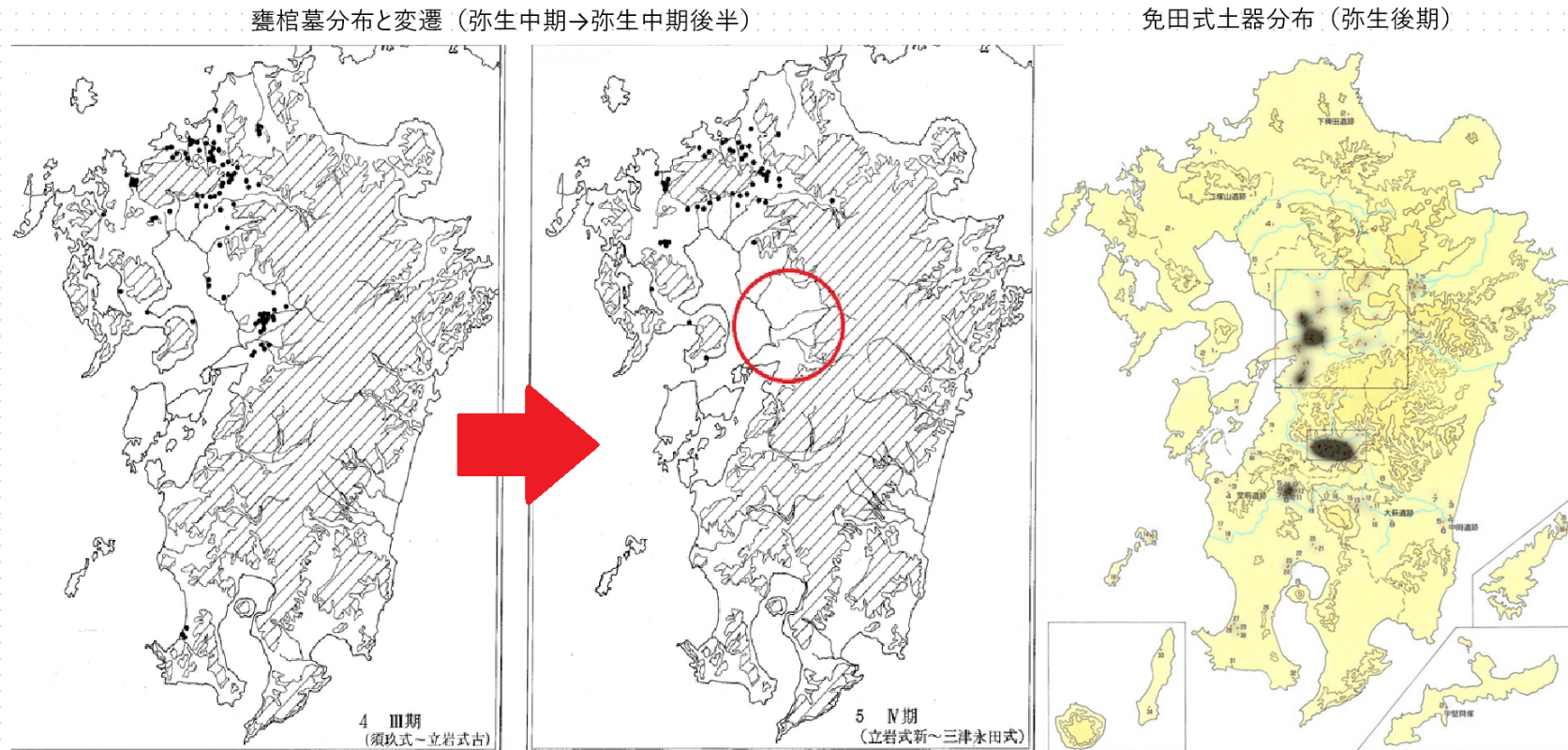
Menda-type pottery has a rounded, abacus-bead-shaped body decorated with a distinctive “layered-arc” (jūkomon) pattern. It is thought to have been a ritual vessel used exclusively in burial contexts. Its densest findspot concentrations lie in the southern Kumamoto Plain south of the Shira-kawa River and along the Kuma River basin.
A critical observation is that Menda-type pottery is almost entirely absent from the Kikuchi River basin, even though the Kikuchi basin lies within the same Kumamoto Prefecture. Late-Yayoi pottery from the Kikuchi basin belongs to the Nobeta-type distribution zone, which is clearly distinct from the Menda-type zone (New Kumamoto City History, General History Volume 1, 1998). On the north bank of the Shira-kawa, the Nishiyagomen site (西弥護免遺跡; Ōzu-machi, Kikuchi-gun, northern Kumamoto)—with its quadruple moat and the largest number of iron arrowheads found at any single domestic Late-Yayoi site—also stood here.
The Shira-kawa River, whose headwaters lie in Mount Aso, is thus thought to have served as the de facto boundary in the Late Yayoi period between “Hi no Kuni” (肥の国; the ancient proto-provincial territory of Hi, corresponding broadly to present-day Kumamoto and Saga Prefectures; the confederation headed by the Queen’s kingdom, i.e., Yamato-koku (邪馬壹国)) and Kuna-koku.
Originally, Kumamoto was a region characterized by dolmen burials (支石墓) within the cultural sphere of the Hi people. Likely following a process of harmonious integration, this mortuary practice transitioned to jar burials during the Middle Yayoi period. The distribution zone of these jar burials was shared as far as the Uto Peninsula via the Ariake Sea—the inland sea on the western coast of Kyushu—linking Kumamoto with the cultural traditions of Tsukushi (northern Kyushu) and Hizen (present-day Saga and Nagasaki)., cultures sharing the jar-burial tradition (the kamekan burial system) as far as the Uto Peninsula. In the Late Yayoi period, however, the Kuma forces advanced northward into the Kumamoto Plain. By gaining control of the Midori-kawa and the Shira-kawa rivers, Kuna-koku came to hold naval dominance over the southern Ariake Sea.
As a result, the large jar coffins produced in the Hizen area (present-day Saga Prefecture) could no longer be transported through the Ariake Sea and Shira-kawa waterway system, and the jar-burial culture in the Kumamoto Plain came to an end. Even the shift in pottery of the Ata region (western Satsuma Peninsula)—an outlier of the jar-burial culture—from Middle-Yayoi northern-Kyushu types to Late-Yayoi Seto Inland Sea types can be interpreted as Kuna-koku blocking the Uto Peninsula gateway to the Ariake Sea.
The Kumamoto Plain south of the Shira-kawa thus fell under Kuna-koku’s control, creating a confrontational structure in which Menda-type pottery (Kuna-koku) and Nobeta-type pottery (Yamato-koku (邪馬壹国)) faced each other across the river. One reading of the Wei Zhi itinerary holds that envoy Ti Jun traveled southward along inland waterways (“Water route 20 days”; “Water route 10 days, land route one month”) rather than via the Ariake Sea after Nakoku (奴国; present-day Hakata, Fukuoka City); this too is coherent as reflecting deliberate avoidance of a sea whose maritime control had become uncertain.
The travel times recorded in these passages—“water route 20 days,” “water route 10 days, land route one month”—should be read not as anomalies requiring explanation but as honest records of the time actually spent. Ti Jun noted how long each leg took; that itself is unremarkable. What is remarkable is what he did not record: distances. The absence of distance data, not the presence of large day-counts, is the key indicator.
Ti Jun’s structural predicament explains both the time and the silence. His imperial rescript authorized him only to “arrive at” (到) Ito; no provisions had been prepared for travel beyond that point. Yet the queen was not at Ito— the Wei Zhi itself makes this explicit in the Ito entry:
He was therefore compelled to press on to Yamato-koku (邪馬壹国; 至 邪馬壹国—the shift from 到 to 至 itself encodes an unplanned extension). The title jianzhong xiaowei (建中校尉) implies a force of roughly 700–5,000 men—a contingent the productive capacity of Wa’s 70,000-odd households could not sustain for long. Starving soldiers become rioters; and all the while, Ti Jun was bound by his formal commission as a goodwill ambassador carrying an imperial edict. Any field commander with a firm grasp of operational realities would have spent his time securing supply before advancing. That is what the large day-counts record: not rhetorical cover, but the actual cost of improvised logistics in hostile territory across the remaining c. 1,400 ri from Nakoku to Yamato-koku (邪馬壹国).
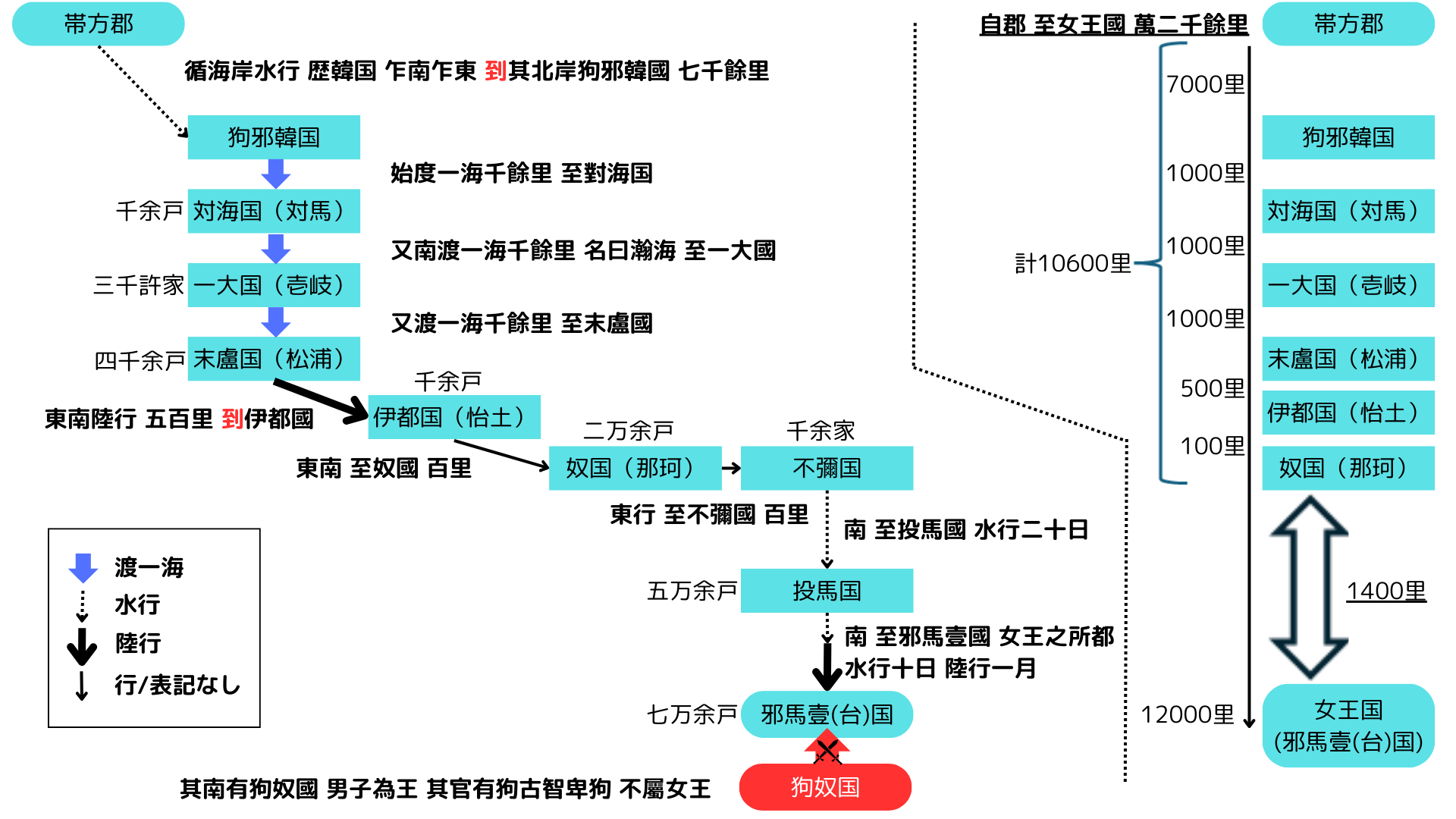
What Ti Jun suppressed in his final report was not the travel time but the severity of Yamatai’s logistical poverty. Distances were omitted; duration was recorded faithfully. This is bureaucratic omission, not fabrication—a careful avoidance of any account that would make plain just how precarious the confederation’s situation truly was.
The logistical argument above finds direct textual corroboration in the Wei Zhi’s own vocabulary. Zhang Mingcheng (1992) demonstrated that in classical Chinese texts including the Shiji, Hanshu, and Sanguo Zhi, the two graphs carry categorically distinct meanings that are never conflated within a single document.
In the Wei Zhi, 到 appears as the destination marker for only two localities: the embarkation point 狗邪韓國 (「到其北岸狗邪韓國」) and, crucially, 伊都国 (「東南陸行五百里、到伊都國」). Every other place on the itinerary—including 邪馬壹国 itself (「南至邪馬壹國」)—is marked with 至. The rescript said arrive at (到) Ito; Yamatai was reached only in the sense of 至—an extension beyond the sanctioned endpoint.
Ti Jun recorded the days faithfully; they were neither hyperbole nor invention. What Ti Jun suppressed in his final report was not the distance itself—which could, after all, be derived by subtracting the recorded legs from the total ri-count—but the severity of Yamato-koku’s logistical poverty. Distances were omitted to avoid a direct account of the confederation's precarious situation, a truth that was nevertheless encoded in the grueling travel times. The two graphs 到 and 至, read with care, preserve for any reader who notices them the exact outline of a mission that exceeded its mandate and an official who chose silence over transparency about what he found at journey’s end.
The Wei Zhi passage 「以朱丹塗其身體 如中國用粉也」 (They coat their bodies with red pigment as people in China use face powder) indicates that red pigment was consumed on a daily, large-scale basis, as a cosmetic. It is difficult to imagine cinnabar—mercury sulfide, a precious commodity in the ancient world—being used so casually and in such quantity. It is therefore more rational to interpret the “丹” in 「其山有丹」 (their mountains have dan) as bengara, a red ochre made from iron oxide, which was abundant and inexpensive.
A competing theory reads “丹” as mercury (i.e., cinnabar), but this is inconsistent with the description of everyday cosmetic use. The companion paper’s analysis of cinnabar procurement (Miyazaki 2026a, DOI: 10.5281/zenodo.19121916) concerns the strategic acquisition of mercury smelting technology that drove the development of gold and silver mining as a driving force behind the formation of the early Yamato court, as evidenced by lead isotope analysis of a late-3rd-century shift in procurement source. This is distinct in material, purpose, and political context from the everyday cosmetic use of iron-oxide-based red ochre (bengara) in Yamatai discussed here.
Some scholars cite the political goal of checking the rival state of Wu as the reason for Wei’s generous treatment of Yamatai. The present author, however, considers that the personal feelings of Emperor Cao Rui—who died the year after the audience—played a substantial role.
In his final years—years increasingly consumed by illness contracted in early middle age—Cao Rui placed faith in the spiritual pronouncements of a shamaness called Dengnu (登女; a shamaness at the Wei court whose prophecies Cao Rui reportedly trusted) and sought what he believed to be divine water (Wei Lüe (魏略; an early 3rd-century Wei historical record, now partially lost, preserved in fragments cited in later commentaries), cited in the subcommentary to the Annals of Emperor Ming, San Guo Zhi). This points to a strong personal interest in shamanic arts and alchemical longevity practices. It is entirely plausible that Cao Rui, with this orientation, was personally captivated by envoys from a distant queen’s kingdom whose people coated their bodies in red ochre (朱丹)—a substance associated with cinnabar and the alchemical tradition.
The titles granted to Yamatai’s envoys—Senior Commander of Good Conduct and Junior Commandant of Good Conduct—corresponded to Grade 5 (equivalent to a stipend of 2,000 koku or above) and came with silver seals and blue ribbons. According to Miyazaki Ichisada (historian of East Asian institutions, 1901–1995) in his Study of the Nine-Rank System of Official Appointment, this rank entailed the right of direct audience with the emperor. It is natural to infer that Cao Rui granted audience privileges on an ad hoc basis precisely because he wished to meet the envoys in person.
How extraordinary this was becomes clear when compared with Wei’s treatment of other foreign peoples. Even powerful chiefs of the Wuhuan and Xianbei—northern peoples who were simultaneously a military threat and important allies of Wei—were mostly given only a bronze seal with yellow ribbon, corresponding to Grades 7 or 8.
Nashime and Toshigori were mere “surrogate envoys” of the queen—not rulers in their own right. Yet they received the silver seal with blue ribbon (Grade 5), far surpassing those northern chiefs who were kings of their peoples. This is a complete departure from the diplomatic protocols of the time. It is precisely the evidence that Cao Rui, driven by strong personal motivation, brought the distant envoys to just in front of the imperial throne.
It is worth noting that in AD 243—four years after Cao Rui’s death in AD 239—the child emperor Cao Fang also conferred the title of Senior Commander of Good Conduct upon Ekiyaku and others. At that age, Cao Fang could hardly have shared Cao Rui’s personal fascination with shamanic arts or distant queen-dom envoys. This later conferral is best understood as bureaucratic precedent-following: the institutional inertia of a rank-class once established by a predecessor, maintained as a matter of administrative routine rather than renewed imperial enthusiasm. From Yamatai’s perspective, the high-grade treatment secured by Cao Rui’s personal interest continued to yield diplomatic dividends long after the emperor who granted it was dead—which itself underscores just how consequential that first exceptional act of conferral had been.
There is a further consequence. For Daifang Prefect Wang Qi, a request for military aid from a Senior Commander of Good Conduct—nominally the same grade as a military officer—could not easily be dismissed. Even while struggling with rebellions in the southern Korean peninsula, in which his predecessor Gong Zun had died in battle (245/246), Wang Qi dispatched Frontier Bureau Clerk Zhang Zheng (Grades 8–9) to Wa in 247. The inflated rank of Yamatai’s envoys thus had a direct practical effect on Wei’s willingness to send help.
When the findings of each section converge, the true image of Yamato-koku (邪馬壹国) emerges: a small-state confederation with its leading base in the middle Kikuchi River basin, facing Kuna-koku across the Shira-kawa while pleading for military aid from Wei. That is the picture this paper presents—fundamentally different from the conventional “Yamatai Hegemonic-State Theory.”
Every element of the “Yamatai Hegemonic-State Theory” stems from misreading or over-interpretation of the Wei Zhi. Approached as a field report, the text reveals not a powerful state but a confederation led by a small polity that stood on the edge of extinction under fierce assault from Kuna-koku. It is this perspective that will prove to be the key to dispelling the haze that has long hung over this debate.
“The Phantom Yamatai”—that is at once the name Miyazaki Kōhei gave to the mysterious kingdom, and the phantom that the illusion of the Hegemonic-State Theory has conjured. When the haze clears, what appears is not a phantom at all: it is the true-to-life portrait of an ancient Yamato (山門)—a queen who prayed without ceasing, who sheltered a thousand women, who watched enemies advance to the far bank of the Shira-kawa, and who endured.
This Yamato-koku (邪馬壹国) was subsequently destroyed by Empress Jingū (the Yamato polity), and its very existence was deliberately erased from history. Two pieces of evidence preserve traces of that erasure.
The first is the Heian-period gazetteer Wamyō Ruijushō (和名類聚抄; compiled by Minamoto no Shitagō, 930s CE), which records a place called “Yamato” (山門) in Kikuchi District, Higo Province (肥後国; present-day Kumamoto Prefecture). This toponym no longer appears on any modern map, making the gazetteer entry the last surviving trace of a place once called “Yamato (山門).”
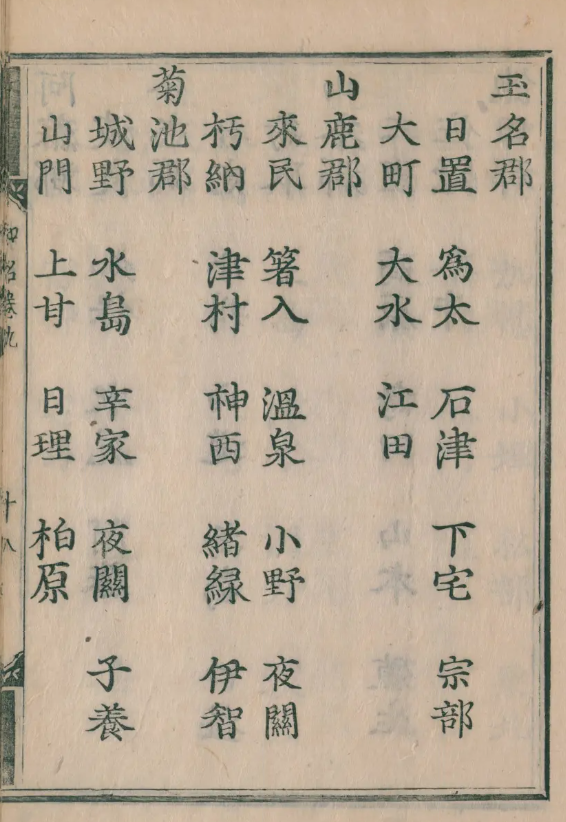
The second is the following passage from Nihon Shoki, Book Nine:
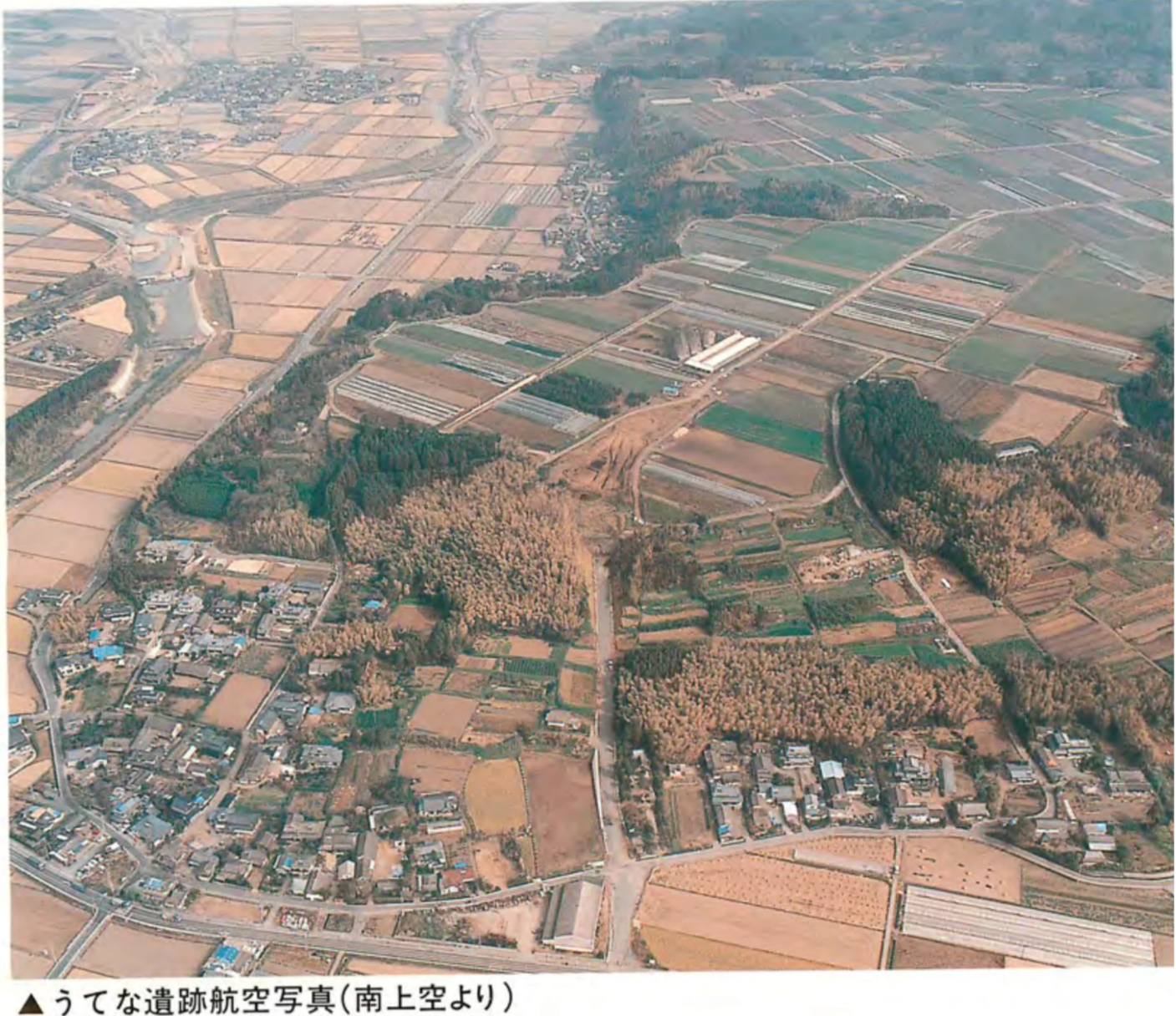
If the 山門縣 (Yamato, written with the characters 山門, “Mountain Gate”) here is identified with the Yamato (山門) of Kikuchi District in Higo (肥後; present-day Kumamoto Prefecture), this passage records the final subjugation of Yamato-koku (邪馬壹国)’s last stronghold by Empress Jingū’s forces. The orthography is decisive: the text writes 山門, not 大和—the same characters found in the Wamyō Ruijushō entry for Kikuchi District. The name “Yamato (山門)” that the queen had once borne was appropriated by the conquering Yamato court (based in the Kinai region, present-day Nara Prefecture); the original territory was rewritten into the historical record as though it had never been distinct. The belated appearance of keyhole-shaped tumuli (zenpōkōenfun, 前方後円墳) in the Kikuchi River basin stands as material evidence that a power distinct from the Yamato realm continued to hold this ground until the very end, and in the place name “Utena” (臺; a hamlet in Shichijō-machi, Kikuchi City, whose name preserves the character 臺 from 邪馬壹国), one may hear the last message that the people of Yamato-koku (邪馬壹国) entrusted to posterity.
That is the Yamato-koku (邪馬壹国) that has been sought for so long.
| # | Claim | Falsifying condition |
|---|---|---|
| 1 | Chronology | A Bayesian model retaining the Hokeno-yama small branch as a high-reliability fixed anchor, preserving the established stratigraphic sequence (Hokeno-yama → Hashihaka), and using IntCal20 alone yields a Hashihaka date converging to before 250 CE or after 350 CE at Amodel ≥ 60%. |
| 2 | Nature of Ichidaisotsu | A Wei or Jin excavated document or inscription explicitly identifies Ichidaisotsu as a military officer holding command authority. |
| 3 | Cause of polygyny | A contemporary Wa document or inscribed artifact — dated to the Wei Zhi period — explicitly attributes the practice of multiple wives to an institutional origin unrelated to war (e.g., status-based privilege or bridewealth custom). |
| 4 | Kukochi-hiku | Archaeological evidence from the Kikuchi River basin demonstrates the predominance of Kuna-koku material culture, confirming Kikuchi as Kuna-koku's domain rather than a conquest target. |
| 5 | Shirakawa boundary | A revised ceramic distribution survey demonstrates significant co-occurrence of Menda-type and Nobeta-type pottery on both sides of the Shirakawa. |
| 6 | "Dan" (丹) as cinnabar | Chemical analysis of red pigments from Yayoi-period sites in the proposed Yamatai territory demonstrates the predominance of HgS (cinnabar) in everyday-use contexts. |
| Version | Date | Changes |
|---|---|---|
| v1.1.0 | 2026-06-16 |
[Figures] Six figures added to both English and Japanese sections:
Fig. 1 (Menda-type pottery distribution map);
Fig. 2 (jar-burial transition → Menda-type, Middle Yayoi Period III→IV);
Fig. 3 (Wei Zhi route diagram and ri-count calculation);
Fig. 4 (Wamyō Ruijushō entry for Yamato/山門, Kikuchi District);
Fig. 5 (aerial photograph, Utena site, Kikuchi City);
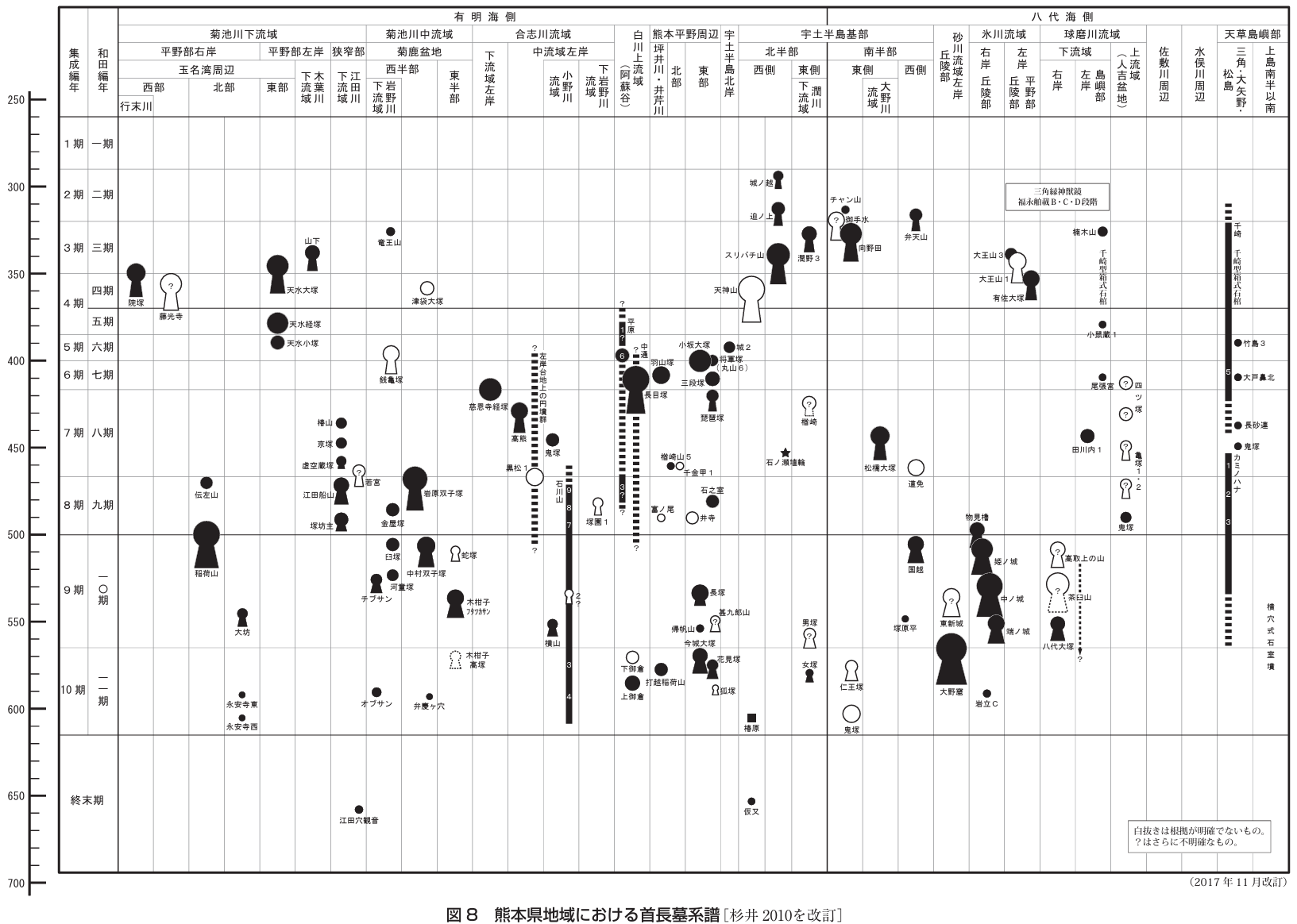
Fig. 6 (chief-burial-mound genealogy, Kumamoto region, revised from Sugii 2010).
[Text — §VIII] Description of companion paper (Miyazaki 2026a) revised: “ritual and mortuary use of mercury sulfide” → “mercury smelting technology driving gold and silver mining development” (EN); same change applied in JA section. [Bibliography] NDL Digital Collections link added to New Kumamoto City History Vol. 1 (EN & JA). Utena site excavation report (Kumamoto Prefectural Board of Education 1992, DOI: 10.24484/sitereports.16405) added to bibliography (EN & JA). |
| v1.0.0 | 2026-06-04 | Initial publication. |
Chen Shou. Sān Guó Zhì (Records of the Three Kingdoms), Wei Shu, “Account of the Eastern Barbarians: Account of the Wa” (Wei Zhi Woren Zhuan); “Annals of Emperor Ming” (明帝紀). Late 3rd century.
Kojiki (Record of Ancient Matters). Middle volume. Compiled AD 712. Cited for the accounts of Emperor Jimmu and Tagishimimi no Mikoto.
Nihon Shoki. Book Nine (Preface to the Regency of Empress Jingū, including the Taburatsu-hime (田油津媛) entry, and others).
Minamoto no Shitagō. Wamyō Ruijushō (和名類聚抄; Japanese Names Classified and Collected). Compiled c. AD 934. Records the place name “Yamato” (山門) in Kikuchi District, Higo Province (肥後国菊池郡). Available at NDL Digital Collections (Frame 19, Kikuchi-gun: Yamato).
Miyazaki Masahiro. “Resource Strategy and State Formation in Ancient Japan: Chemical Reinterpretation of Mizu naku shite Ame wo Tsukuru, Spatial Statistics of Mononobe Shrines, and Reexamination of Chronology.” Zenodo, 2026a. DOI: 10.5281/zenodo.19121916. [Miyazaki 2026a; companion paper to the present article (Miyazaki 2026b); includes full OxCal code and Bayesian radiocarbon analysis.]
Miyazaki Masahiro. “Reconstruction of 3rd-Century Japanese Phonetics Based on the Wei Zhi Woren Zhuan.” Zenodo, 2025. DOI: 10.5281/zenodo.18065799.
Harunari Hideji, Imamura Mineo, Nishimoto Toyohiro, Sakamoto Minoru, Fujio Shin’ichirō. “Radiocarbon Dating of the Period of Tumulus Emergence.” Bulletin of the National Museum of Japanese History (Rekihaku), Vol. 163, 2011. DOI: 10.15024/00001872.
Reimer, Paula J., et al. “The IntCal20 Northern Hemisphere Radiocarbon Age Calibration Curve (0–55 cal kBP).” Radiocarbon, Vol. 62, No. 4, 2020, pp. 725–757. DOI: 10.1017/RDC.2020.41.
Sakamoto Minoru. “The Calibration Curve IntCal20 and Japanese Tree Rings.” Makimuku Studies, No. 10, Makimuku Studies Center, 2022, pp. 301–308. PDF available online.
Hosoya Aoi. “Archaeology without Theory—In Order to Understand Japanese Archaeology.” Paper presented at the Theoretical Archaeology Group (TAG) 1996 Annual Conference, University of Liverpool, 1996. Available online (English).
Japan Ancient History Network. “On the Freedom-of-Information Litigation.” https://nihonkodaishi.net/topics/inf-disclosure.html (last confirmed May 21, 2026). Includes the inquiry letter of December 1, 2025, and the Nabunken response.
Naitō Kōnan (内藤湖南). Himiko-kō (卑彌呼考; A Study of Himiko). 1910. The seminal text of the Kinai hypothesis (畿内説), proposing that Himiko’s realm corresponded to the Yamato region of the Kinai. Available online (Aozora Bunko).
Shiratori Kurakichi (白鳥庫吉). Wa no Jowō Himiko-kō (倭女王卑弥呼考; A Study of Himiko, Queen of Wa). 1910. The seminal text of the Kyushu hypothesis (九州説), arguing on philological grounds that Yamatai lay in northern Kyushu. Available online (Aozora Bunko).
Kondō Yoshiki (1801–1880). Seikan Kigen (征韓起源), cited as the pioneer of the theory identifying Yamatai with the Yamato district, Kikuchi-gun, Higo Province (肥後国菊池郡山門郷).
Kondō Yoshirō. Zenpōkōenfun no Jidai (前方後円墳の時代; The Age of Keyhole-Shaped Tumuli). Iwanami Shoten, 1983. A foundational study of the Kofun period; cited here as a reference point for the “uniform keyhole-tumulus system” model that the present paper’s Hegemonic-State critique calls into question.
Terasawa Kaoru. Ōken Tanjō (王権誕生; The Birth of Royal Power). Kōdansha, 2000. The leading contemporary statement of the Kinai–Makimuku hypothesis, cited as the representative position against which the present paper’s alternative chronology and location argument is directed.
Ōta Akira. New Studies in Ancient Japanese History (Nihon Kodaishi Shinkenkyū). Isobe Kōyōdō, 1928. DOI: 10.11501/1176513. NDL Digital Collections, p. 65.
Miyazaki Kōhei. Phantom Yamatai (Maboroshi no Yamataigoku). Kōdansha, 1967. The work that ignited popular interest in the Yamatai debate.
Nakahara Hideshi. The Ancient Lake “Moga no Ura” and “Kuna-koku” Kikuchi. Kumamoto Shuppan Bunka Kaikan / Sōryū Shuppan (distributor), 2016.
Kikuchi Hideo. Yamatai, Kuna-koku, and Iron (Yamataigoku to Kunakoku to Tetsu). Sairyūsha, 2010.
Itō Masafumi. Yamatai Was in Kumamoto!: Yamatai as Seen Through the Theory of Post-Facto Falsification of the Wei Zhi Woren Zhuan. Fusōsha Shinsho, 2016.
Kusumi Takeo. “3rd-Century Chikushi, the Three Han States, and Wa.” In Futakami Yamatai Symposium 17: Grand Summary Symposium Proceedings (『魏都・洛陽から『親魏倭王』印の旅』), ed. Futakami Shiyūkai (Friends of Kashiba City Futakami History Society / Nijōzan Museum). March 2017. Available on Academia.edu.
Nakazono Satoshi. “Southern Kyushu in the Era of Yamatai and Its Inter-Regional Relations.” In Kuni-guni in the Yamatai Era: Southern Kyushu (『邪馬台国時代のクニグニ 南九州』), ed. Futakami Shiyūkai. Futakami Shiyūkai, April 2014.
Isahaya City Board of Education. Isahaya City Cultural Properties Survey Report 1: Survey Report on the Fūkanzake Dolmen Group (諫早市文化財調査報告書1:風観岳支石墓群調査報告書). Isahaya City Board of Education, 1976. DOI: 10.24484/sitereports.15745. [Documents a dolmen group within the Hi no Kuni (肥の国) sphere, supporting the archaeological delineation of the Queen’s confederation territory.]
Fujio Shin’ichirō. “Jar Coffins of Kyushu: Distribution and Transition of Yayoi-Period Jar-Burial Mounds.” Bulletin of the National Museum of Japanese History (Rekihaku Kenkyū Hōkoku), vol. 21, March 1989. DOI: 10.15024/00000412.
Kumamoto Prefectural Museum of Decorated Tumuli. Prayers of Yayoi People: The Mystery of Menda-type Pottery (Exhibition Catalogue 3). 1993. DOI: 10.24484/sitereports.22178.
New Kumamoto City History Editorial Committee, ed. New Kumamoto City History: General History, Vol. 1 (Natural, Prehistoric, and Ancient Periods). Kumamoto City, March 1998. 554 pp. NDL Digital Collections.
Kumamoto Prefectural Board of Education. Utena Site (うてな遺跡). Kumamoto Prefectural Cultural Properties Survey Report, Vol. 121. Kumamoto Prefectural Board of Education, 1992. National Buried Cultural Properties Database. DOI: 10.24484/sitereports.16405. [Excavation report for the Utena site, Shichijō-machi, Kikuchi City; primary source for the “Utena” (臺) place name and associated archaeological remains.]
Sugii Takeshi. “The Background to the Emergence of Elite Chief Tomb Lineages in the Early Kofun Period as Seen Through the Rise and Fall of Late Yayoi Settlements: Why Were Kofun Built There?” Bulletin of the National Museum of Japanese History (Rekihaku), vol. 211, March 2018, pp. 351–407. DOI: 10.15024/0000002421.
Shirai Katsuya. “The Rokutō Trade and the Haranotōji Trade: Exchange in the Yayoi Period as Seen Through Clay-Band Pottery, Three-Han Pottery, and Lelang Pottery.” In Proceedings of the 49th Conference on Buried Cultural Properties: Exchange in the Yayoi Period—Movement of Goods and Their Bearers, ed. Executive Committee of the 49th Conference on Buried Cultural Properties Research. pp. 157–176. 2001. Available online.
Miyazaki Ichisada. Study of the Nine-Rank System of Official Appointment (Kyūhin Kanninhō no Kenkyū). Tōyōshi Kenkyū Sōkan, 1956. On the rights and privileges attached to Grade-5 rank in the Wei bureaucratic system.
Sekio Shirō and Nakamura Keiji. “The Society and Economy of the Three Kingdoms.” In Chinese History Vol. 2: Three Kingdoms to Tang (Chūgokushi 2: Sangoku–Tō), ed. Ikeda On. World Historical Series, Yamakawa Shuppansha, 1996. ISBN 4634461609. On the evolution of the cishi (刺史) office into the Wei–Jin period and the introduction of military authority under zhōumù and concurrent generalship commissions.
Zhang Mingcheng. Full of Misreadings: Yamatai—If a Chinese Person Were to Read the Kojiki and the Wei Zhi. Kubo Shoten (Jias Books 3), 1992. On the original meaning of 率 (shuài) as “leader / director” in classical Chinese, and on the interpretation of key Wei Zhi terms from a native Chinese-reading perspective.
『魏志倭人伝』(魏書東夷伝倭人条、西暦297年頃成立)は、3世紀の日本を記した唯一の同時代外国史料であり、邪馬台国の所在と性格をめぐる長年の論争の主要な根拠となってきた。しかし、広範な先行研究にもかかわらず学術的合意は得られていない。本稿は、その根本的障害が「邪馬台国強国説」と呼ぶべき固定観念――魏志を強大な軍事国家の記述として読むこと――にあると論じる。関連記事の精読と独立ベイズ放射性炭素分析を組み合わせることにより、この先入観を多方面から解体する。畿内説の根拠とされてきた春成・歴博モデル(箸墓古墳=西暦240〜260年)は、IntCal20による再計算でAmodelが16%にとどまり、国際的受容基準の60%を大幅に下回ることを示す。代替モデルでは箸墓の築造年代が3世紀末〜4世紀初頭に収束し、「箸墓=卑彌呼の墓」論の年代的根拠は消滅する。魏志を文学テキストではなく官僚的フィールドレポートとして読み直すと、一大率は軍事司令官ではなく民政の物流官であること、広範な多妻婚は男性戦死者50%超に起因する広義の氏族内寡婦収容型婚姻慣行であること、千人の侍女は卑彌呼の権威のもとに庇護された戦争未亡人たちであること、そして対魏朝貢の主目的は金印獲得ではなく狗奴国との戦争における援軍要請であったことが明らかになる。官名「狗古智卑狗」の再解析は、菊池が狗奴国の支配地域ではなく征服目標であることを示し、邪馬壹国を現在の熊本県菊池川流域に位置づける。白川が二国間の弥生時代後期の事実上の境界線であることは、免田式土器と野部田式土器の異なる分布によって考古学的に支持される。これらを総合すると、邪馬台国を含む女王国は強国ではなく、滅亡寸前の小国連合であったことが示される。
キーワード:邪馬台国;邪馬壹国;山門;魏志倭人伝;卑彌呼;ベイズ放射性炭素年代測定;氏族内寡婦収容慣行;レビレート婚;継母婚;狗奴国;菊池川流域;弥生時代;甲類;上代特殊仮名遣い
邪馬台国をめぐる学術論争は、日本古代史上で最も大規模かつ多面的な論争のひとつである。珍しいことに、専門研究者だけでなく、古代史に関心を持つ一般市民も広くこの議論に加わってきた。論点は、国家の所在地、その名称の意味、史料に記された距離・行程、国家の政治的性格、そして女王・卑彌呼の正体に及ぶ。
ではなぜ、これほど多くの議論が積み重ねられても、卑彌呼が居住した邪馬台国の座標はいまだ特定できないのか。本稿は、その根本的原因が「邪馬台国強国説」と呼ぶべき幻想にあると論じる。そのうえで、『魏志倭人伝』(以下「魏志」)の中で最も誤読を生じやすい箇所を、一項目ずつ丁寧に検討する。 本稿の論述は二つの軸から構成される。第一軸は「強国説の解体」――魏志の記述を誇大解釈する先入観を批判的に除去すること。第二軸は「実像の再構築」――強国説の前提を外したうえで浮かび上がる、菊池川流域の小国連合という実像の提示である。第一軸は第二軸の論証を可能にする方法論的前提として機能する。
邪馬台国をヤマトと同一視し、卑彌呼を神功皇后に比定する見解は、少なくとも『日本書紀』(神功皇后摂政39年条)の時代から存在する。近世以降、新井白石(儒学者、1657〜1725年)、本居宣長(国学者、1730〜1801年)、近藤芳樹(漢学者、1801〜1880年)らが九州各地への比定論を唱えてその見解に挑戦し、邪馬台国は大和ではないという認識が徐々に広まった。
近代学術論争は20世紀初頭、東京・京都両帝国大学の史学者らが九州説・畿内説をめぐって論戦を展開したことに始まる。以後、多くの研究者がこの論争に加わり、大論争へと発展した。
戦後、自由な言論下で邪馬台国問題は国民に広く普及し、藤間生大の連合国家論、井上光貞の原始的民主制、上田正昭の古代専制国家論など政治体制の議論も活発化した。
一般ブームに火を付けたのは、宮崎康平(作家・在野の歴史研究家、1913〜1980年)の著書『まぼろしの邪馬台国』(1967年)である。本稿の標題はこの著作から取った。
近代的論争から百年余りを経た現在も、日本各地で独自の所在地を主張する「ご当地邪馬台国」が林立しており、論争は依然として混迷を極めている。
2000年代以降、放射性炭素(14C)年代測定が日本考古学に本格的に適用されるようになった。春成秀爾(国立歴史民俗博物館、以下「歴博」)は、当時の国際標準較正曲線IntCal09と歴博独自の較正曲線JCALを用いて箸墓古墳の炭化物を測定し、築造年代をAD240〜260年と推定した(春成ほか、2011年)。この年代が卑彌呼の没年に近接するとして、邪馬台国の「畿内(ヤマト盆地)説」への支持が急激に高まった。しかしこの春成・歴博モデルには、統計的問題と手続き的問題の二重の欠陥がある。
現在の国際標準較正曲線IntCal20(IntCal09の後継)による再計算では、Amodelが16%にとどまり、深刻な適合不良を示す(坂本稔・歴博教授(研究部情報資料研究系・博士(理学))、2022年)。OxCalの国際基準では60%以上を許容範囲とし、30%未満を統計的棄却の閾値とする。16%はその閾値を大幅に下回り、モデルの前提自体が崩壊していることを意味する。筆者による独立再現では19.3%を得た(宮崎 2026a、DOI: 10.5281/zenodo.19121916)。
JCALは光谷拓実(奈良文化財研究所・年輪年代学者)が作成した年輪年代データに基づく。この基礎データは30年以上にわたって第三者への開示が拒否されてきた。情報公開訴訟の末に加工済みデータの一部が開示されたものの、東京高裁(2025年8月)により原本を含む残存資料の開示は司法的に不可能と確定した。さらに、開示されたデータについても既発表値と一致しないとの指摘がある(日本古代史ネットワーク、2025年12月)。
論理的連鎖は明快である。光谷データが独立検証できない以上、それに基づくJCALも検証できず、JCALを使用する春成・歴博モデルも同様に検証不可能である。検証不可能な較正曲線に基づく年代推定は、科学的証明たりえない。
筆者は他の研究者の手法を参考に、土器付着物を除外しホケノ山の小枝を、高信頼性固定アンカーとしてIntCal20のみを用いた代替モデルを構築した。そのAmodelは64.9%であり、国際基準を満たす。このモデルの下で箸墓の年代は3世紀末〜4世紀初頭(AD280〜320年代頃)に収束し、「箸墓=卑彌呼の墓」論の年代的根拠は消滅する。詳細は宮崎 2026a(DOI: 10.5281/zenodo.19121916)を参照されたい。当モデルのOxCalコードおよび試料データは同論文内に完全公開されており、第三者による独立した検証・再現が可能である。
所在地的にも年代的にも両柱を失った畿内説の残像を払拭したとき、邪馬台国の真の座標はどこに求めるべきか。その鍵は意外な場所に潜んでいる――「邪馬台国強国説」という幻想の中に。
こうした統計的棄却を無視してまで「箸墓=卑弥呼の墓」という説が定説化した背景には、細谷(1996)が喝破した日本考古学界の構造的欠陥がある。細谷は、理論なき日本考古学が「群盲象を撫でる」状態にあり、マスコミや行政のプレッシャーの中で「話題性の高いデータ」が選別されるバイアスを指摘した。本稿で批判する「邪馬台国強国説」こそが、まさにその「色眼鏡」の正体である。「巨大な前方後円墳には、巨大な女王が眠っているはずだ」という、実務的・数理的な裏付けを欠いたロマン主義的投影が、IntCal20という冷厳な統計的指標(Amodel 16%)を直視することを妨げてきたのである。統計的に破綻したモデルに固執し、原本データの開示を拒む現状は、細谷が30年前に予言した「理論を捨て、閉鎖的な自閉に陥った日本考古学(細谷、1996年)」の末路を、最も皮肉な形で体現していると言わざるを得ない。
多くの人が、邪馬台国をおおよそ次のようなイメージで描いている。
しかしこれらのイメージはいずれも、魏志の誤読から生じている。以下の各節で、これらの誤読を生む核心的記述を検討する。
邪馬台国が伊都国に兵を駐留させ、一大率によって周辺諸国を軍事的に監視したとする説がある。これは誤りである。魏国における刺史(Regional Inspector)は文官職であった。刺史が軍事権を兼ねる場合には州牧(Provincial Governor)という別称が用いられるか、刺史が文官職とは別に将軍号を兼任する形式が取られた。
魏の地方官の序列は以下のとおりである。
魏志が「刺史の如し」と描写する一大率は、したがって純粋な文官職である。実務的には、弥生時代の主要交易港である伊都国に常駐する物流行政官としての役割を担っていた。
諸国が一大率を畏れ憚った真の理由は、軍事力ではない。魏志に「皆、津に詣り、文書・賜遺の物を検察す」とある通り、一大率は交易物資・外交物品の厳格な検品官であった。当時の倭国では「その犯法、軽き者はその妻子を没し、重き者はその門戸及び宗族を没す」(其犯法 輕者没其妻子 重者没其門戸及宗族)という峻厳な法が運用されており、検品上のわずかな誤りが即座に一族の破滅を意味した。諸国が恐れおののいたのは、剣や兵士の存在ではなく、この非情なまでの実務的重圧――行政上の失態が氏族の存亡に直結するという厳格さ――に対してである。
「率」は漢籍における原義では「統率者・長」を意味する(張明澄・古代史研究者、1992年)。「一大」とは、魏志が壱岐国を指して用いた国名「一大国」の「一大」そのものである。なお、「一大国」は魏志倭人伝の原典(百衲本)の表記であり、「一支国」は後漢書(432年頃成立)以降にのみ現れる後世の写本代替字であって、3世紀の魏志正文を反映しない。本稿は魏志原典に従い「一大国」と表記する。魏志が壱岐を「一大国」と表記すること自体、魏志倭人伝の音写官が閉鎖音節の倭語音に閉鎖音節の漢字を対応させたという音写原理――「一」(*ʔjit、閉鎖音節)が壱岐の詰まる音を、「大」(*dat、閉鎖音節)が石田(壱岐の中核地区)の音節融合を写す――と整合する(宮崎、2025年、DOI: 10.5281/zenodo.18065799)。即ち「一大率」とは「一大国(=壱岐・石田)担当長官」を意味し、軍事的含意はない。壱岐の原の辻遺跡と伊都国の三雲遺跡は、「原の辻―三雲交易路」とも呼ぶべき流通ネットワークの物流結節点であった。
壱岐国の石田郡(現・壱岐市石田町)は原の辻遺跡の所在地であり、「一大」の音価を考えるうえで直接参照される地名である。上代特殊仮名遣いでは「田」は通常、開放音節(甲乙の区別なし)として扱われる。にもかかわらず音写官が閉鎖音節字「大」(*dat)を用いたのはなぜか。
その説明として「音節融合仮説(語中音消失:syncope)」が有力である。「石 (ishi)」の末尾は無声歯擦音 [ʃ] であり、後続する「田 (ta)」の高母音 [i](もしくはその前渡り音)は、無声子音に挟まれた環境で無声化・脱落する。この現象は言語普遍的な法則(英語の choc'late・veg'table、ラテン語 calidus → イタリア語 caldo など)に対応し、日本語でも「月 (tsuki)」の [u] 無声化に代表される。結果として「石田 (ishi-ta)」は「イシッタ」のように詰まった音響として実現し、音写官の耳には閉鎖音節として知覚された、と考えられる。
この例外が「畿内大和 (yamato)(乙類ト)」には適用されない理由も明快である。「大和」の先行音節「マ (ma)」は鼻音であり、無声化を誘発する音響的条件を持たない。「ヤ・マ・ト」の三音節はそれぞれ明瞭に独立して発音されるため、「ト」が詰まった音として知覚される余地はない。したがって「畿内大和」の「ト」(乙類)を閉鎖音節字「壹」(*ʔjit)で写すことはあり得ない。もし開放音節として音写するとすれば「都」のような開放音節字が用いられるべきであり(「邪馬都国」)、閉鎖音節字「壹」や「大」(*dat)は使えない。本稿の音写モデルが「山門」→「邪馬壹国」と「石田(壱岐国石田郡)」→「一大国」を整合的に説明できるのは、この文脈依存的な音響変化に根ざしているためである。詳細は別稿(宮崎、2025年、DOI: 10.5281/zenodo.18065799)を参照。
生物学的に男女の出生比はほぼ1対1である。一般庶民でも二〜三人の妻を持つことが普通であれば、その原因を女性の出生率の高さに求めることはできない。成人男性が極端に少なかった――最も蓋然性が高いのは、大量に戦死したためである――と結論せざるをえない。
別の説明として「征服地の女性を娶った」という仮説も一応は考えられる。しかしこれは魏志の用語法それ自体によって否定される。魏志倭人伝は戦争捕虜の女性を「婦」ではなく「女生口」と明記している(「奉汝所獻、男生口四人、女生口六人」――魏帝から卑彌呼への返書)。「生口(せいこう)」は奴隷・捕虜を指す語であり、「婦(妻)」とは制度上も語義上も別カテゴリである。多妻婚の記述に使われているのは「婦」であって「生口」ではない以上、征服で獲得した女性捕虜が「下戸の二〜三婦」として計上されていたとは考えられない。
多くの文化に見られるレビレート婚(死んだ兄弟の未亡人を妻とする慣習)は、より広い制度的カテゴリの一下位類型にすぎない。「庶民も二〜三人の妻を持ち、女性は嫉妬しない」という記述は、制度的義務の描写として読むことができる――戦死した夫の氏族の男性が未亡人を引き取ることを義務づけられていたのである。「女性が嫉妬しない」という一節は、個人的意思ではなく制度的諦念を反映している。儒教的価値観を持つ魏の使者にとってこれは野蛮な慣習と映ったはずであり、直接的な表現を避けた内容とされたのであろう。平均的な成人男性が二人の妻を持つとすれば、邪馬台国における成人男性の戦死率は50%を超える計算となる。 本稿では、「氏族内寡婦収容慣行(Widow-retention practice)」という語を、この制度的慣行を最も広義に指す用語として使用する。すなわち、レビレート(兄弟の未亡人を娶る)・継母婚(父の未亡人を娶る)・その他氏族内の形態を含む、戦禍で夫を亡くした女性を氏族内の男性が引き取るあらゆる制度的慣行を指す。すべての変形例に共通する社会的論理は一貫している――保護者を失った女性の社会的孤立を防ぎ、氏族の資源や戦略的に重要な女性が競合集団に流出することを阻止することである。これは「野蛮な風習」ではなく、男性戦死率が壊滅的水準に達した状況下における制度的生存戦略――存亡の危機から生まれた社会保障制度――として理解すべきである。4-3節で取り上げる手研耳命の事例(継母婚)は、この広義の慣行の変形例であり、同一の社会的論理に基づくものとして本稿の枠組みと完全に整合する。
代替ベイズモデルの下では、ヤマト王権の成立はAD301年頃、すなわち3世紀末〜4世紀初頭と推定される(宮崎 2026a、DOI: 10.5281/zenodo.19121916)。これは古事記の神武天皇記が描く世界と魏志が描く世界がほぼ同時代であることを意味し、同時期の風俗を伝える資料として古事記を援用することが正当化される。
古事記の中巻によれば、神武天皇崩御の後、先后の子である手研耳命(タギシミミノミコト)は、神武の皇后であった比売多多良伊須気余理比売(ヒメタタライスケヨリヒメ)を自らの妻とした――つまり継母を娶ったことになる。文化人類学的には、これは狭義のレビレート婚(兄弟の未亡人を娶る)ではなく、継母婚(継承婚)に分類される。しかし両者はいずれも、4-2節で定義した氏族内寡婦収容慣行(Widow-retention practice)の下位類型である。その社会的論理――夫を亡くした女性を氏族内に留め、社会的孤立や氏族資源の流出を防ぐこと――はすべての変形例に共通する。この伝承は古事記にのみ記され、日本書紀には存在しない。
この欠如は示唆的である。神武天皇の遠征は九州の筑紫日向を出発点とし、神武も手研耳も九州起源の集団に属する。この婚姻慣行は九州に固有の慣習を反映しているものと考えられる。手研耳命にとって継母を娶る行為は氏族規範上の当然の権利であり義務でもあったが、畿内の在来的価値観からは不義として映ったと考えられ、それ自体が両者の文化的隔たりを示す傍証となる。日本書紀の沈黙は儒教的倫理観に基づく編集方針の反映であろう――口承に残っていた古い九州の規範が正式な王朝史書にそぐわない「不都合な真実」としての排除を示唆している。
本稿の立場――邪馬台国を九州に置くこと――からすれば、建国期のヤマトに父の未亡人の承継が記録されている事実、および久米歌に前妻・後妻をめぐる楽舞が残されていることは、偶然ではなく同一文化圏における連続性を示している。これは、『魏志倭人伝』の多妻婚記事が単なる「蛮習」の報告ではなく、戦時下の氏族社会において機能していた「生存戦略としての制度的慣行」であったことを裏付ける、日本側からの決定的証拠といえる。
※ヤマト王権の具体的な出自と東征の軍事的背景については、別稿で詳述予定。
千人の侍女は「自ら」卑彌呼に仕えており、指示によるものではない。卑彌呼の実際の身の回りの世話をするのは男性一人だけである。つまり侍女たちは卑彌呼に直接給仕しているわけではなく、通常の女官とは性格が異なる。故にこれは、戦死者の激増により夫や息子といった守り手を失っただけでなく、もはや次代を産み育てる年齢を過ぎて社会的に孤立した女性たちを、卑彌呼という聖的権威の名において救済・集約していた社会実態の反映と解釈すべきである。
魏志は邪馬台国の規模を「凡そ七万余戸」と記す。しかし第IV節で見たように成人男性の半数以上が不在となった実態は、稼ぎ手・保護者を失った世帯の累積である。千人の女性を卑彌呼が庇護したという異例の記録は、通常の女官制度ではなく、最高位の首長が保護者のない夥しい人口を引き受けざるをえなかった社会的現実を映していると解すべきである。人口は豊富でも労働力が不足するこの社会像は、大国の証拠としてではなく、滅亡寸前でかろうじて持ちこたえる連合体の姿として一貫して理解できる。
邪馬台国が対魏朝貢を行った目的は金印の獲得ではなく、狗奴国との戦争における軍事援助の要請であった。以下の外交年表がそれを明示する。
金印を授与された後も243年・247年と繰り返し使者が送られ、魏はついに軍事援助(張政ら)を派遣した。この二つの事実が、邪馬台国が滅亡寸前であったことを明示している。
魏志は狗奴国の官名を「狗古智卑狗」(3世紀推定音 *kɔʔ-kɔʔ-tij-pij-kɔʔ、「ココチピコ」)と記す。これを和語に置き換えれば「菊池彦」となり、現在の熊本県菊池川流域が狗奴国の支配領域であるという印象が生まれる。その読みに従えば、邪馬台国は菊池川流域より北に位置しなければならない。しかしこの解釈には、これまで見落とされてきた重大な問題がある。
前述のとおり「一大率」は「一大(壱岐)担当長官」を意味し、その職の対象地域名を冠している。これは当時の倭国における官名付与の慣行を示していると考えられる――官名は対象地域名を頭に置く形で構成された。後世の用例にも並行例がある。吉備地方を平定した者は「吉備津彦」と呼ばれた。「征夷大将軍」という称号はそのターゲットを名称に刻んでいる。なお「一大率」における「一大(壱岐)」が管轄・駐在地を示す「管轄地型」であるのに対し、「征夷大将軍」における「蝦夷」および「狗古智卑狗」における「狗古智(菊池)」は征討対象地を示す「征討対象型」である。両者はいずれも「官名に関連地名を冠する」という命名慣行の下位区分として整合的に理解できる。
この慣行を「狗古智卑狗」に適用すれば、解釈は根本的に逆転する。「狗古智(菊池)」は狗奴国の支配領域ではない。狗奴国が征服しようとしていた地域であり、その名が官名に冠されているのである。すなわち「狗古智卑狗」とは「菊池征服将軍」を意味する。
ここで一点方法論上の留保を明示しておく。魏志倭人伝に記録された倭の官名は、史料の性格上、数が限られている。本論の論証は用例の統計的多寡に依拠するものではなく、確認できる二つの事例――一大率と狗古智卑狗――が単一の一貫した命名規則のもとで整合するかどうか、という内的整合性の検証に基づいている。一次史料が二事例しか提供しない場合、方法論的に正しい対応は仮説的用例を増やすことではなく、その二事例が同一の規則に収まるかを厳密に問うことである。本稿はその問いに肯定的に答える。
菊池秀夫(考古学者・歴史家)は著書『邪馬台国と狗奴国と鉄』において狗古智卑狗を「肥後狗奴国の女王連合に対する前線指揮官」と定義する。しかしその「前線」が向き合う拠点こそ、まさに狗古智(菊池)であった。これは菊池が狗奴国の支配下にあった証拠ではなく、菊池が狗奴国にとって最優先の征服目標であった証拠である。
音韻的には Kuna(*koʔ-nɔ)と Kuma(球磨)の間に子音の乖離があるが、これは魏が同盟国・女王国の敵に対して音韻的正確さより政治的貶称を優先し、意図的に蔑称文字――狗(犬)、奴(奴隷・蛮夷)――を当てたことで説明できる。「狗奴(クナ/クマ)」は熊本平野南部から人吉盆地(おおむね現在の熊本市から鹿児島県北西部)にかけての地域に比定される。弥生時代後期の熊本県において球磨郡を中心に免田式土器が密集して分布することも、この比定を支持する。
戦線の構図は以下のとおりである――球磨を拠点とする狗奴国が熊本平野まで北上して、菊池川流域に拠点を置く邪馬台国を攻撃した。「狗古智卑狗」はその前線を指揮した将軍の官名である。邪馬台国が魏に繰り返し援軍を懇請した切迫した理由も、これで説明がつく――狗奴国の攻勢が菊池川流域まで迫っていたのである。
「熊本県=狗奴国」という図式は通説のように流通しているが、考古学的実態を無視した粗雑な二項対立である。弥生時代後期の熊本県には、土器分布によって明確に区別できる二つの文化圏が共存していた。
弥生時代中期、北部九州で栄えた甕棺墓の墓制は熊本平野にも広く分布し、南は宇土半島方面まで及んでいた。しかし後期になると、この甕棺墓の風習は熊本平野から急速に消滅する。それに替わって拡大したのが、球磨郡免田町(現あさぎり町)出土品を標式とする免田式土器である(熊本県立装飾古墳館『弥生人の祈り 免田式土器の謎』企画展図録3、1993年)。
免田式土器は丸みを帯びたそろばん玉形の胴部に「重孤文」と呼ばれる特徴的な文様を持ち、専ら埋葬に用いられた儀礼的器物と考えられている。その最密集地帯は白川以南の熊本平野南部と球磨川流域に分布する。
決定的な観察は、同じ熊本県内にありながら菊池川流域では免田式土器がほとんど出土しないという事実である。菊池川流域の弥生時代後期土器は野部田式の分布圏に属し、免田式とは明確に区別される(『新熊本市史』通史編第1巻、新熊本市史編纂委員会編、1998年)。白川北岸には、四重環濠を持ち国内最多の鉄鏃が出土した弥生時代後期の西弥護免遺跡(菊池郡大津町)も位置している。
阿蘇山を源とする白川はかくして、弥生時代後期における「肥の国」連合(女王国・邪馬壹国を盟主とする)と狗奴国の事実上の境界線として機能していたと考えられる。
もともと熊本は、支石墓を墓制とする「肥(ひ)の人」の圏域に属する地域であった。弥生時代中期に入ると、おそらくは融和的な統合のプロセスを経て、その墓制は甕棺(かめかん)墓へと移行する。当時、この甕棺墓の分布圏は、九州西岸の内海である有明海を介して広がり、南は宇土半島方面にいたるまで、北部九州や肥前と共通の文化基盤が共有されていたのである。しかし弥生時代後期になると球磨の勢力が熊本平野を北上した。緑川・白川の制水権を掌握することで、狗奴国は有明海南部の制海権を握った。
その結果、肥前地域産の大型甕棺が有明海・白川水系を経由して運搬されなくなり、熊本平野の甕棺文化は終焉を迎えた。阿多地方(薩摩半島西部)の土器が弥生中期の北部九州系から後期の瀬戸内系に移行した変化も、狗奴国が有明海への宇土半島ルートを封鎖したことの反映と解釈できる。
こうして白川以南の熊本平野は狗奴国の支配下に入り、免田式土器(狗奴国)と野部田式土器(邪馬壹国)が川を挟んで対峙する構図が成立した。
「水行二十日」等の移動日数は、速度の問題ではなく、兵站確保にかかった実時間の記録として読むべきである。梯儁が倭地での日数をそのまま記したことは何ら不自然ではない。問題は日数ではなく、距離が記されていないことにある。
加えて、建中校尉・梯儁の置かれた構造的苦境を直視する必要がある。彼に与えられた詔書の命令は「到伊都国」まで――すなわち伊都国への到着が任務の範囲であり、それ以降の兵糧は用意されていなかったと考えられる。しかし女王は伊都国にはおらず、急遽「至」邪馬壹国へ向かわざるをえなくなった。その根拠は魏志倭人伝の伊都国条そのものに明記されている。
魏本国との補給線は海を隔て事実上絶たれていた。建中校尉の推定兵力は魏の「校尉」という官名から700〜5,000人規模とみられるが、戸数70,000余という邪馬台国の生産力でこれを長期にわたって支えることは困難であった。飢えた兵士は暴徒と化す――その危機を抱えながら、梯儁は同時に「勅命の使者・親善大使」という職責も果たさなければならなかった。本国から遠く離れた倭地でこの二律背反の状況に直面した梯儁が、実務を知る軍事指揮官であれば兵站の確保に時間を費やしたはずである。それが、奴国から邪馬壹国への1,400里に「水行二十日」「水行十日陸行一月」を費やした理由である。
梯儁が帰国後の報告書において糊塗したのは、移動日数ではなく邪馬壹国の兵站の貧弱さそのものであった。距離は伏せられ、要した時間だけが記されている。これは虚偽ではなく、倭地の窮状を正直に伝えることを避けた官僚的省略である。
上述した兵站論的解釈は、魏志倭人伝の文字そのものによって直接補強される。張明澄(1992年)は、『史記』『漢書』『三国志』などの中国古典において「到」と「至」は明確に区別され、同一文書内で混用された例はないことを実証している。
魏志倭人伝において「到」が目的地標識として用いられているのは、渡海地点の狗邪韓國(「到其北岸狗邪韓國」)と伊都国(「東南陸行五百里、到伊都國」)の二箇所のみである。それ以降の全行程――女王の都する邪馬壹国でさえ(「南至邪馬壹國」)――はすべて「至」で記されている。詔書が「到(=到達すべき終点)」として指定したのは伊都国だけであり、邪馬壹国は「至(=及んだ先)」、すなわち任務範囲外の延長であった。梯儁は日数を忠実に記録した。それは誇張でも捏造でもない。 彼が最終報告書において抑制(オミッション)したのは距離そのものではなかった。なぜなら距離自体は、記録された各区間の里数を総里数から差し引けば、結局のところ算出可能なものだからである。彼が真に伏せたのは、計算によって導き出される距離そのものではなく、邪馬壹国(やまとこく)が直面していた深刻な兵站(ロジスティクス)上の脆弱さだったのである。「到」と「至」の用字法は、当初の命令範囲と現実の行動範囲の乖離を文字の上で静かに刻んでいる。その用字の差に気づく読者のためにのみ、梯儁の置かれた状況の真実が魏志に残されている。
魏志の「以朱丹塗其身體 如中國用粉也」(朱丹をもってその身体に塗ること、中国で粉(おしろい)を用いるが如し)という記述は、赤色顔料が化粧品として日常的かつ大量に消費されていたことを示す。水銀硫化物である辰砂――古代世界では貴重な物資であった――がこれほど気軽に大量使用されたとは考えがたい。したがって「其山有丹」の「丹」は、豊富で安価な酸化鉄製の赤色顔料であるベンガラと解釈するのが合理的である。
「丹」を水銀(辰砂)と読む説もあるが、日常的な化粧品使用の描写と矛盾する。なお、別稿(宮崎 2026a、DOI: 10.5281/zenodo.19121916)が論じる辰砂の戦略的調達は、鉛同位体比分析が示す3世紀末の産地転換を根拠に初期ヤマト王権における成立の原動力となった水銀製錬技術からの金銀鉱山の開発を論じるものであり、邪馬壹国における日常的化粧用ベンガラ消費とは用途・品質・政体の三点において別文脈に属する。
魏の邪馬台国への厚遇の理由として、ライバル国・呉を牽制する政治的目的を挙げる論者もいる。しかし筆者は、謁見の翌年に崩御した明帝・曹叡の個人的感情が大きな役割を果たしたと考える。
若くして病に侵された晩年に登女という巫女の言う神を信じて神水を求めるなど(『三国志』明帝紀裴注所引『魏略』)、巫術・錬丹術への強い関心を持っていた曹叡が、身体に朱丹を塗る、奇抜な遠方の女王国使者に個人的な興味を抱いた可能性は十分に考えられる。
倭の使者に授けられた率善中郎将・率善校尉の称号は五品(秩2000石相当以上)に対応し、銀印青綬が付された。宮崎市定(東アジア制度史研究者、1901〜1995年)の『九品官人法の研究』によれば、この位階は皇帝への直接謁見権を伴う。曹叡が使者と直接会いたかったがゆえに、その場限りで謁見権を付与したと推測するのは自然である。
この異例さは他民族への待遇と比較すれば一目瞭然である。同時に軍事的脅威でかつ重要な同盟者でもあった烏丸・鮮卑の有力首長たちでさえ、大半は七〜八品に相当する銅印黄綬しか与えられていない。
難升米・都市牛利は女王の「代理使者」にすぎず、自国の支配者ではない。にもかかわらず彼らは銀印青綬(五品)を得た――自国民の王である北方首長たちを大きく凌ぐ待遇である。これは当時の外交慣例からの完全な逸脱であり、曹叡が強い個人的動機のもとに、遠方の使者を皇帝の玉座の目前まで引き寄せた証拠にほかならない。
なお、曹叡の崩御(AD239年)後のAD243年には、幼帝・曹芳もまた掖邪狗らに率善中郎将の位を授けている。この時点で曹芳はまだ幼少であり、曹叡のような巫術・錬丹への個人的関心が動機となったとは考えにくい。これは先帝が打ち立てた格式に倣った官僚的な前例踏襲と解するのが自然であろう――倭国側から見れば、一度確立された高位の扱いが制度的惰性によって維持された形である。逆に言えば、曹叡による最初の破格の叙爵がなければ、その後の手厚い対応の連鎖も生じなかったことを示している。
さらに重要な帰結がある。帯方郡太守・王頎にとって、名目上は武官と同等の位を持つ率善中郎将からの援軍要請を、容易には退けられなかったはずである。朝鮮半島南部の叛乱――王頎の前任者・弓遵がこれで戦死(245/246年)――に苦しみながらも、王頎は247年に塞曹掾史・張政(八〜九品)らを倭に派遣した。倭の使者への格上された位階は、魏が援助に応じることへの直接的な実務効果をもたらしたのである。
各節の知見が収束するとき、邪馬壹国の真の姿が浮かび上がる――菊池川中流域に主要拠点を置き、白川を隔てて狗奴国と対峙しながら魏に援軍を懇請し続けた、小国連合の姿である。これは従来の「邪馬台国強国説」とは根本的に異なる像である。
「邪馬台国強国説」を構成するすべての要素は、魏志の誤読ないし過大解釈から生じている。フィールドレポートとして魏志に向き合えば、そこに見えるのは強大な国家ではなく、狗奴国の猛攻のもとで滅亡の淵に立ちながらも耐え続けた、小さな首長連合の姿である。この視点こそが、この論争を長年覆ってきた霞を晴らす鍵となるだろう。
「まぼろしの邪馬台国」――それは宮崎康平がその謎の王国に与えた名前であり、強国説という幻想が生み出したまぼろしでもある。霞が晴れたとき、そこに現れるのはまぼろしではない。祈ることをやめず、千人の女性を庇護し、白川の対岸に迫る敵を見つめながら、それでも耐え続けた古代ヤマト(山門)の、等身大の肖像である。
この邪馬壹国は、後に神功皇后(ヤマト王権)によって滅ぼされ、その存在は意図的に歴史から抹消されたと考えられる。その傍証は、二つの史料に刻まれている。
第一は、平安時代の地誌『和名類聚抄』(源順、930年代)が肥後国菊池郡に「山門」という地名を記録していることである。この地名は2026年現在の地図には存在せず、かつてそこに「ヤマト(山門)」と呼ばれた地が実在したことを示す最後の痕跡である。
第二は、日本書紀巻第九に記された次の一節である。
「山門」が肥後国菊池郡の山門に比定されるなら、これは邪馬壹国の最後の拠点が神功皇后軍によって制圧された記録と解釈できる。かつて女王が戴いた「ヤマト(山門)」という名称は征服者である畿内の王権に奪われ、本来の領域は書き換えられた。菊池川流域における前方後円墳築造の遅れは、この地に大和王権とは異なる勢力が最後まで盤踞していた物証であり、七城町の地名「臺(うてな)」は、かつての邪馬壹国の人々が後世に託した最後のメッセージかもしれない。
それが、長く求め続けられてきた邪馬壹国の姿である。
| # | 主張 | 反証条件 |
|---|---|---|
| 1 | 年代論 | ホケノ山の小枝を高信頼性固定アンカーとして維持し、考古学的に確立された層位的前後関係(ホケノ山→箸墓)を保持したうえで、IntCal20のみを用いたベイズモデルにおいて、箸墓古墳の年代が Amodel ≥ 60% を維持しながら250年以前または350年以降に収束した場合。 |
| 2 | 一大率の性格 | 魏・晋代の出土文書または碑文が、一大率を軍事指揮権を持つ武官と明示した場合。 |
| 3 | 多妻婚の起因 | 魏志倭人伝と同時代の倭地の史料・出土文字資料が、多妻婚の慣行を戦争と無関係な別の制度的起源(身分的特権・婚資慣行等)に明示的に帰属させた場合。 |
| 4 | 狗古智卑狗の解釈 | 菊池川流域の考古資料が狗奴国系物質文化の優勢を示し、菊池が征服目標ではなく狗奴国の支配地域であったことが確認された場合。 |
| 5 | 白川境界線 | 改訂版土器分布調査が免田式・野部田式土器の白川両岸における有意な共存を実証した場合。 |
| 6 | 丹の性格 | 邪馬壹国比定地域の弥生時代遺跡における赤色顔料の化学分析が、日常使用の文脈においてHgS(辰砂)の優勢を示した場合。 |
| バージョン | 日付 | 変更内容 |
|---|---|---|
| v1.1.0 | 2026年6月16日 |
【図版追加】英語版・日本語版の両本文に図版6点を追加:
図1(免田式土器出土分布図);
図2(甕棺墓分布変遷〔弥生中期III期→IV期〕と免田式土器分布);
図3(魏志倭人伝行程図・里数計算);
図4(和名類聚抄・肥後国菊池郡「山門」記載箇所);
図5(うてな遺跡航空写真、菊池市七城町);
図6(熊本県地域首長墓系譜、杉井2010を改訂)。
【本文修正・§VIII】別稿(宮崎 2026a)の辰砂研究の記述を修正:「水銀硫化物の祭祀・防腐用途」→「水銀製錬技術からの金銀鉱山の開発」(英語版・日本語版ともに適用)。 【参考文献】『新熊本市史 通史編第1巻』に国立国会図書館デジタルコレクションのリンクを追加(英語版・日本語版)。うてな遺跡調査報告書(熊本県教育委員会1992年、DOI: 10.24484/sitereports.16405)を参考文献に追加(英語版・日本語版)。 |
| v1.0.0 | 2026年6月4日 | 初版公開。 |
陳寿『三国志』魏書「東夷伝倭人条」(魏志倭人伝)、「明帝紀」。3世紀末成立。
『古事記』中巻。712年成立。神武天皇・手研耳命の記述を参照。
『日本書紀』巻第九(神功皇后摂政前紀・田油津媛処刑条、摂政39年条ほか)。
源順『和名類聚抄』(10巻本)。平安時代中期、934年頃成立。肥後国菊池郡に「山門」の地名を記録。 国立国会図書館デジタルコレクション(19コマ左、菊池郡「山門」)
宮崎政宏「辰砂資源調達構造の再構成と古代国家形成モデル――『無水造飴』の化学的解釈、物部神社の空間統計、および年代学の再検証」Zenodo、2026a。DOI: 10.5281/zenodo.19121916。[宮崎 2026a;本稿(宮崎 2026b)の関連論文;OxCalコード全文および放射性炭素ベイズ分析を含む。]
宮崎政宏「魏志倭人伝に基づく3世紀日本語音韻の再構」Zenodo、2025年。DOI: 10.5281/zenodo.18065799。
春成秀爾・今村峯雄・西本豊弘・坂本稔・藤尾慎一郎「古墳出現期の炭素14年代測定」『国立歴史民俗博物館研究報告』第163集、2011年。DOI: 10.15024/00001872。
Reimer, Paula J. ほか「IntCal20 北半球放射性炭素年代較正曲線(0〜55 cal kBP)」 『Radiocarbon』第62巻第4号、2020年、725〜757頁。 DOI: 10.1017/RDC.2020.41。
坂本稔「較正曲線IntCal20と日本の年輪」『纒向学研究』第10号、纒向学研究センター、2022年、301〜308頁。PDF公開。
細谷葵「理論なき考古学――日本考古学を理解するために」Theoretical Archaeology Group (TAG) 1996年次大会(リヴァプール大学)発表論文、1996年。オンライン公開。
日本古代史ネットワーク「情報公開請求訴訟について」https://nihonkodaishi.net/topics/inf-disclosure.html(2026年5月21日最終確認)。2025年12月1日付照会状および奈文研回答を含む。
内藤湖南『卑彌呼考』1910年。畿内説の原点となる論考。卑彌呼の王国を畿内ヤマトに比定する議論の嚆矢。青空文庫にて公開。
白鳥庫吉『倭女王卑弥呼考』1910年。九州説の原点となる論考。文献学的根拠から邪馬台国を北部九州に比定する議論の嚆矢。青空文庫にて公開。
近藤芳樹(1801〜1880年)『征韓起源』。肥後国菊池郡山門郷に邪馬台国を比定した先駆者。
近藤義郎『前方後円墳の時代』岩波書店、1983年。古墳時代研究の基礎文献。本稿が批判的に参照する「前方後円墳体制」論の基盤を提供した著作として引用。
寺沢薫『王権誕生』講談社、2000年。畿内・纒向説の現代における代表的論著。本稿の代替年代論・所在地論が対峙する主要な立場として参照。
宮崎康平『まぼろしの邪馬台国』講談社、1967年。邪馬台国論争への一般的関心を喚起した先駆的著作。
太田亮『日本古代史新研究』磯部甲陽堂、昭和3年(1928年)。DOI: 10.11501/1176513。国立国会図書館デジタルコレクション、65頁。
中原英『太古の湖「茂賀の浦」と「狗奴国」菊池』熊本出版文化会館、創流出版(発売)、2016年。
菊池秀夫『邪馬台国と狗奴国と鉄』彩流社、2010年。
伊藤雅文『邪馬台国は熊本にあった!――魏志倭人伝後世改ざん説からみた邪馬台国』扶桑社新書、2016年。
久住猛雄「3世紀のチクシと三韓と倭国」、ふたかみ邪馬台国シンポジウム17『総別シンポジウム』資料集(『魏都・洛陽から「親魏倭王」印の旅――楽浪・帯方・三韓から邪馬台国へ――』)、香芝市二上山博物館友の会ふたかみ史遊会発行・編集、2017年3月。Academia.edu にて公開。
中園聡「邪馬台国時代前後の南九州とその地域間関係」、香芝市二上山博物館友の会ふたかみ史遊会編『邪馬台国時代のクニグニ 南九州』、ふたかみ史遊会、2014年4月。
諫早市教育委員会『諫早市文化財調査報告書1:風観岳支石墓群調査報告書』諫早市教育委員会、1976年。 DOI: 10.24484/sitereports.15745。 [肥の国(女王国連合の領域)内に位置する支石墓群の調査報告。]
藤尾慎一郎「九州の甕棺――弥生時代甕棺墓の分布とその変遷」『国立歴史民俗博物館研究報告』第21集、1989年3月。DOI: 10.15024/00000412。
熊本県立装飾古墳館『弥生人の祈り 免田式土器の謎』企画展図録3、1993年。DOI: 10.24484/sitereports.22178。
新熊本市史編纂委員会編『新熊本市史 通史編第1巻(自然・原始・古代)』熊本市、1998年3月、554頁。国立国会図書館デジタルコレクション。
熊本県教育委員会『うてな遺跡』熊本県文化財調査報告第121集、熊本県教育委員会、1992年。全国遺跡報告総覧。DOI: 10.24484/sitereports.16405。 [菊池市七城町うてな地区の発掘調査報告書。「臺(うてな)」地名および遺跡の基礎資料。]
杉井健「弥生時代後期集落の消長よりみた古墳時代前期有力首長墓系譜出現の背景――なぜそこに古墳は築かれたのか」(第3部 倭の地域社会)、『国立歴史民俗博物館研究報告』第211集、国立歴史民俗博物館、2018年3月、351〜407頁。DOI: 10.15024/0000002421。
白井克也「勒島貿易と原の辻貿易――粘土帯土器・三韓土器・楽浪土器からみた弥生時代の交易」、『第49回埋蔵文化財研究集会 弥生時代の交易――モノの動きとその担い手――』、埋蔵文化財研究会第49回研究集会実行委員会、2001年、157〜176頁。オンライン公開。
宮崎市定『九品官人法の研究』東洋史研究叢刊、1956年。魏の九品官位制における五品の権限(皇帝謁見権)について。
関尾史郎・中村圭爾「三国の社会経済」池田温 編『中国史2 三国〜唐』世界歴史大系、山川出版社、1996年。ISBN 4634461609。魏晋における刺史の軍事権化(州牧・将軍号の兼帯)と都督の台頭について。
張明澄『誤解だらけの邪馬台国――中国人が古事記と魏志を読んだら』久保書店(Jias Books 3)、1992年。漢籍における「率」の原義(統率者・長)の考証、および魏志の主要術語に関する中国語母語者による読解。